Fantasy · Wednesday
Borrowed Rain
The rain is exactly what she promised. The kingdom beneath it isn't. To move the storm across the border, a hedge-wizard must sacrifice the land her brother depends on.
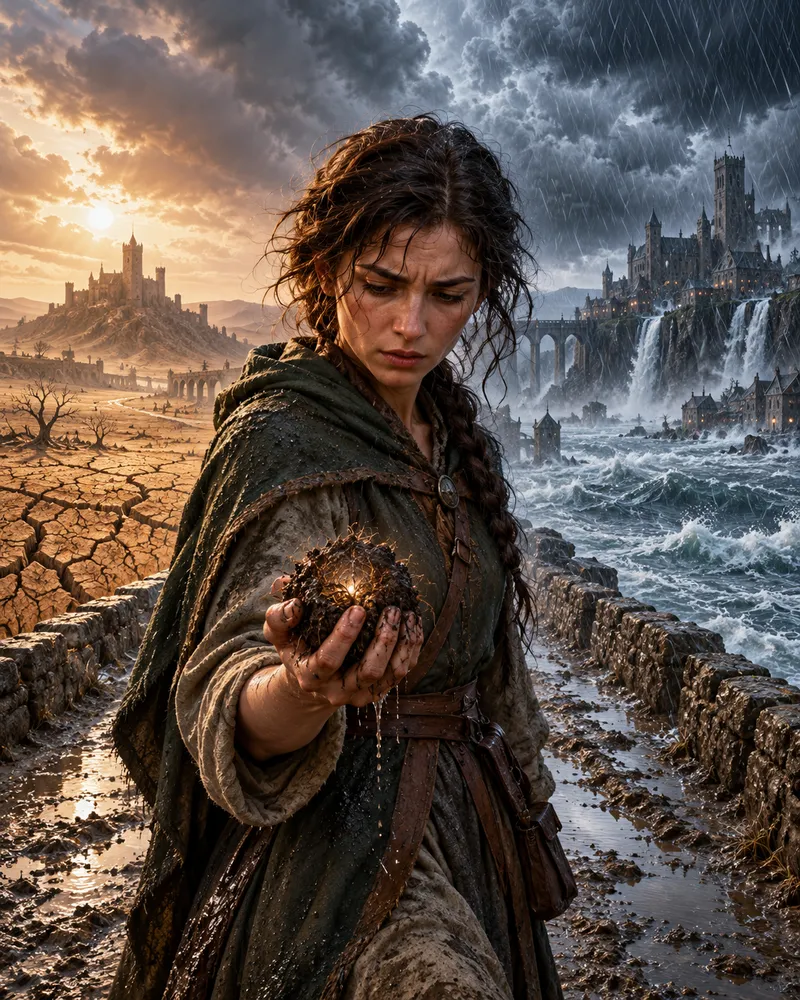
Dru stood on the Silt Road causeway, her boots sinking into a cold, brown seep. To her left, the kingdom of Dunhollow lay in a desperate, cracking drought. To her right, the kingdom of Carrick was drowning under a relentless, sideways downpour. In Dru’s palm sat a plum-sized fist of dark loam—the soil anchor. She pressed her thumb into the damp earth and felt a warm, rhythmic pulse. It wasn’t the steady hum of Dunhollow; it was a Carrick heartbeat. The rain was falling on the wrong kingdom.
The Wrong Rain
Dru stood at the center of the Silt Road causeway, the dividing line between two worlds. To her west, Dunhollow was gold and brown. The earth had cracked into deep, jagged fissures that looked like thirsty mouths open to a white-hot sky. She could see the smudge of her kitchen roof in the distance, surrounded by two hundred acres of wilting wheat and stunted corn. The air there smelled of hot stone and dried grass.
To her east, Carrick was a blur of slate grey and vibrant green. A massive, concentrated downpour slammed into the valley, turning the horizon into a shimmering curtain of water. This wasn’t a gentle spring shower; it was a week’s worth of rain compressed into a few frantic hours. The planting rows were already dissolving, the rich topsoil sliding away in miniature mudslides that raced toward the river.
In her left hand, Dru held the anchor. It was a small, dense sphere of dark loam, no bigger than a plum, warm to the touch and heavy with moisture. She closed her eyes and pressed her thumb deep into the center of the soil.
A pulse met her. It was a rhythmic, wet thrum—a heartbeat that resonated through her fingertips and up her arm. This was the kingdom-mark. Dru had felt this signature a thousand times in her own fields, but as she listened to the anchor, she realized with a jolt of panic that this wasn’t Dunhollow soil. The pulse was faster, more fluid. It was Carrick riverbank earth.
“You idiot,” she whispered, her voice barely audible over the roar of the rain.
The spell was already cast. The rain wasn’t just falling; it was anchored to the soil in her hand. Because the anchor belonged to Carrick, the sky was pouring everything it had into the eastern kingdom, treating the anchor like a magnet pulling water from the clouds.
From the east bank, a woman’s voice pierced the noise, shouting that the seedbeds were washing out. Dru looked toward the sound and saw figures battling the flood, but she couldn’t move yet. She was trying to pull the rain toward herself, imagining the water leaping across the border to save Dunhollow. She strained, her muscles tightening, but the rain didn’t budge. It clung stubbornly to the east.
The anchor was too strong; it held the weather in a tight grip. Dru looked back toward her home in the west and felt a flicker of dread. She knew that moving the rain required more than just effort—it required a replacement. To bring the water home, she would have to swap the Carrick soil for a handful of her own.
She stared at the pulsing loam in her hand. The calculation was simple but brutal: to save the harvest of two kingdoms, she might have to sacrifice the very thing that fed her family.
Sable’s Ledger
Dru hurried toward the causeway market, her boots splashing through shallow puddles. The market was a chaotic sprawl of overturned crates and damp canvas tents. In the center stood Sable, the soil merchant, packing away jars of various earths with quick, nervous movements. Her fingers were stained three different colors: ochre, charcoal black, and a pale, ghostly grey.
Dru marched up to the stall and slammed the anchor onto the wooden counter. The wet clump of loam left a dark smudge on the cedar.
“You sold me this as wild ground,” Dru said, her voice tight. “No kingdom mark. Neutral.”
Sable stopped mid-motion, a jar of river silt held in her hand. She looked at the anchor, then up at Dru. Her eyes widened slightly. “It is wild ground! I dug it from the banks myself. It should be blank.”
Dru reached out and pressed her thumb into a fresh jar of the same soil sitting on the counter. The moment her skin touched the earth, she felt it: that same warm, rhythmic pulse.
“It’s Carrick,” Dru said. “This isn’t neutral ground; it’s riverbank loam from the east.”
Sable’s shoulders slumped. She didn’t look guilty so much as bewildered. “I’ve sold that same batch to forty different casters, Dru. Forty! It’s never gone wrong before. The mark was so faint I could barely feel it myself.”
“A whisper is enough when you’re casting a rain-call,” Dru replied. “Now Carrick is drowning and Dunhollow is cracking.”
Sable reached into her apron and pulled out a small pouch of copper coins, offering them as a refund. Dru ignored the money. The damage wasn’t a transaction; it was a catastrophe. She picked up the anchor again, feeling its steady heartbeat against her palm.
The sound of heavy hoofbeats approached. Bess, the family mule, arrived with a rhythmic clop-squelch. Pell sat atop her, dragging a heavy sack of dried corn over his shoulder. Bess stamped her left forefoot impatiently on the hard-packed earth of the causeway, her ears pinned back in annoyance at the dampness.
Pell slid off the mule and walked toward them, his eyes scanning the horizon. He looked west to their dry farm, then east to the grey curtain of rain.
“The water is still moving east,” Pell said. “Is it fixed yet?”
“I have to replace the anchor with our own soil,” Dru answered.
Pell went very still. He stopped midway through shifting the corn sack, his gaze locking onto the fist of loam in Dru’s hand.
“The sterilization,” Pell said. “The whole farm?”
Dru nodded. “Two hundred acres. The wheat, the corn, the apple trees. All of it will go grey.”
Pell looked back toward their home. He could see the same things Dru did—the cracked earth and the thirsty wheat. But he also saw the identity of his life: two hundred acres of ancestral land that had fed them since they were children.
“You can’t,” Pell said firmly. “We can survive a drought. We can dig deeper wells. But if we give up the fertility of our soil, we aren’t farmers anymore. We’re just people living on a patch of grey dust.”
He turned Bess around and began to lead her back toward the farm. He didn’t look back. Dru stood alone in the market, clutching the warm Carrick soil, watching her brother retreat into the dry gold of their home.
Breaking the Surface
By midday, the water had claimed the Silt Road. The causeway was no longer just a path; it was a shallow, brown river. Six inches of silt-laden water surged over the packed earth, rising steadily as the rain in Carrick intensified.
Dru waded toward the eastern edge, where the water was deepest. Wren, a Carrick farmer, was there, her skirts tucked up around her waist, wading chest-deep into the flood to reach a row of struggling seedlings. Beside her, eight-year-old Toss worked with frantic energy. He was on his tiptoes, his small hands clawing at the muddy earth to keep the young plants from being swept away.
Toss held a single, broken sprout in his right hand, clutching it as if it were a treasure. To calm himself, he hummed a counting song—one-two-three, seed for me—though he was consistently off-key.
“You made this!” Wren shouted over the roar of the water. She wasn’t angry, but her voice carried the weight of desperation. “You can unmake it, Dru! Please!”
Dru looked at the anchor in her hand. The Carrick pulse was now a thumping drum. She didn’t want to surrender the farm yet, so she tried a workaround: splitting the anchor.
She closed her eyes and imagined the resonance as a tangled knot of roots. With her fingers, she worked the soil in her palm, trying to pull the Carrick “identity” out of the loam while leaving a neutral core behind. She wanted to redirect the rain without paying the full price of sterilization.
The soil resisted. As she pulled, she felt the resonance fight back. It wasn’t a single thread she could pluck; it was an entire network woven into every grain of sand. No matter how hard she pushed, the rain remained anchored to Carrick.
Wren splashed toward her, grabbing Dru’s wrist with a mud-slicked hand. “You’re trying to half-fix it! Stop playing with the edges, Dru. Replace the anchor!”
“I know,” Dru whispered. “But I don’t have Pell.”
Toss tugged at Wren’s sleeve, pointing toward the center of the causeway. “Aunt Wren, the duck went in the water!”
Wren didn’t look away from Dru, but she reached back to steady the boy. “I know, Toss. Hold your sprout. Don’t let go.”
Dru looked west. The drought in Dunhollow was becoming a physical pressure, a heaviness in the air that smelled of dust and desperation. She tried one last time to force the rain to shift, but the anchor remained stubborn.
The rule was absolute: you cannot negotiate with an anchor. You either keep it or you replace it.
As she watched Toss clutch his sprout, Dru realized that her “half-fix” was a luxury they no longer had. The water was rising, and the seedlings were disappearing. She turned and began to trek back toward Dunhollow, heading for the one person who held the key to the fix but refused to turn it.
Two Hundred Acres
The light over Dunhollow was a flat, searing gold. When Dru entered the kitchen, the air was thick with the smell of dried herbs and dust. Pell was standing by the stove, stirring a pot of tea. He didn’t look up as she entered; he simply listened to the sound of her wet boots on the hardwood floor.
Dru walked to the center table and placed the anchor there. It dripped slowly onto the polished wood, leaving a dark, damp circle.
“I need you to stand in the circle, Pell,” Dru said softly.
Pell stopped stirring. He looked at the soil, then at his sister. “The rain is still falling east?”
“Yes. And it’s getting heavier.”
“And the cost is still the same?”
“Everything we have,” Dru admitted. “Two hundred acres of living earth. The wheat, the corn, the apple trees. All of it will go grey.”
Pell sighed, a sound that seemed to carry all the weight of the drought. He stepped away from the stove and walked toward the window. Outside, their fields looked like a mosaic of cracked porcelain. “The drought is killing us, Dru, but at least the soil is ours. If we sterilize it, we’re gambling on a future where we might not even have a place to stand.”
“We’re gambling on a future where Carrick doesn’t starve,” Dru countered.
Pell shook his head. “I can’t do it yet,” he whispered. “Just one more day. Let’s give it one more day of drought.”
Dru didn’t argue. Instead, she picked up the anchor and walked out into the field. She couldn’t wait another day. The pressure in her chest was too great.
She knelt in the center of their driest plot and drew a circle in the dust with her finger. She placed the Carrick anchor in the center and closed her eyes. She decided to try the ritual solo, even though she knew it required two hands of one bloodline for stability.
As she began the replacement sequence, Dru felt the Carrick resonance begin to lift from the soil. But without a second hand to “seat” the new Dunhollow soil, the energy stalled.
Then, the ritual seized.
The warmth of the Carrick kingdom-mark left the anchor and surged into Dru’s palm. She gasped as a deep, wet brown color began to bleed through her skin. Her veins weren’t turning blue or purple; they were turning the color of rich loam.
The resonance climbed up her wrist, pulsing like a second heart. Her fingers began to sink into the anchor. The soil wasn’t just sticking to her; it was bonding. The gaps between her fingers filled with wet earth, fusing her hand to the plum-sized sphere.
“Pell!” she screamed, but her voice was thin.
She looked down at her forearm. A dark brown line was racing toward her elbow, pulsing in time with the rain three hundred yards away. She had become a bridge. The anchor was no longer just in the soil; it was in her body. If the resonance reached her chest, she would integrate completely—she would become a living anchor, and the rain would follow her until her body eventually dissolved into the earth.
She knelt there, frozen in the dust, her hand fused to the loam, watching the brown veins climb higher as the sun dipped below the horizon.
The Drowning Child
The causeway had become a chaotic river of silt. The rain was no longer just falling on Carrick; it was splitting. Because Dru was half-integrated with the anchor, the spell was confused. Water began to fall in sheets over both kingdoms, creating a shimmering veil of grey that blurred the border.
Wren was now waist-deep in the water, her face strained with effort. Beside her, Toss had lost his grip on his broken sprout; it vanished into the brown current. He was no longer just helping; he was fighting for survival. The current grew stronger, pulling at the boy’s legs.
Toss began to hum his counting song again, though it was now a frantic, breathless sound. One-two-three, seed for me… He slipped, and for a moment, the water surged over his head. Wren lunged, grabbing his arm, but the current was pulling him toward the low point of the causeway where the water drained into the river.
Pell arrived at the edge of the flood on Bess. The mule stamped her left forefoot, refusing to step another inch into the brown water. Pell leaped from Bess’s back and waded in, his boots churning through the silt.
He reached Toss just as the boy was sliding backward. Pell grabbed the other arm, and together he and Wren hauled the shivering eight-year-old toward the bank. Toss coughed up a mouthful of river water, clutching at the air with empty hands, still humming off-key.
Once the boy was safe on the grass, Pell turned his head. A hundred yards to the west, in the middle of their dry field, he saw Dru.
She was on her knees, motionless. From this distance, she looked like a statue carved from dust and loam. But as Pell squinted, he saw the dark brown line running from her fingertips all the way up to her shoulder. Her hand was still fused to the anchor, and her body was swaying slightly, as if she were being pulled by an invisible tide.
Pell marched across the dry earth toward his sister. He knelt beside her, his breath hitching when he saw her hand. The soil had filled every crease of her palm, bonding to her skin like a second layer of flesh. The veins in her arm were a deep, pulsing brown, vibrating with the rhythm of the rain.
He touched her forearm. Her skin was unnaturally warm. The brown line had reached her collarbone.
Pell looked at his sister’s face. She was pale, her eyes closed in concentration, fighting to keep the resonance from reaching her heart. He looked back at the causeway, where Wren and Toss were watching them, then down at the cracked earth of their home.
He reached out and placed his large, calloused hand over Dru’s fused one.
“I’m not doing this for Carrick,” Pell said, his voice flat and honest. “And I’m not doing it for the wheat.”
Dru opened her eyes, a small smile touching her lips despite her exhaustion.
“I’m doing this because you’re going to die if I don’t,” he added.
As his hand locked with hers, the tension in Dru’s arm snapped. The soil between her fingers loosened slightly, and the dark brown veins stopped their climb toward her chest. The resonance was no longer migrating; it was waiting for the final command.
Grey
Two hands held the anchor: Dru’s left, Pell’s right. They knelt together in the center of the field, their fingers interlaced around the small sphere of loam. The Carrick pulse was a steady, driving heartbeat between them.
“Now,” Dru whispered. “Pull.”
Dru focused all her will on the pull. She imagined the Carrick resonance as a deep root system anchored in the soil. She tugged upward, drawing the identity of the eastern kingdom out of the loam. It felt like pulling a heavy silk curtain through water—slow at first, then suddenly fluid.
The warmth surged through her palm and then vanished with a long, wet exhalation. The anchor beneath their hands changed instantly. The dark, rich brown faded into a pale, chalky grey. The pulse stopped. The soil was no longer “Carrick”; it was just inert dirt.
“My turn,” Pell whispered.
Pell reached down with his free hand and scooped up a handful of their own Dunhollow soil—dry, crumbly, and desperate. He pressed this new earth into the center of the grey anchor, seating it like a key turning in a lock.
A small, audible click resonated through their joined hands. The anchor pulsed once, twice, and then settled into a steady, warm hum. The rain had a new home.
Then, the payment began.
First came the worms. Hundreds of them surfaced simultaneously, pale and blind, pushing through the soil in clusters. They crawled over Dru’s knees and Pell’s boots, some winding around their ankles. Dru felt them squirming against her shins, a frantic migration toward the edges of the field. They were leaving the farm because the life was draining out of it.
Next came the color. A wave of grey spread outward from the anchor, moving like a stain through water. Dru watched a single young seedling at her elbow; she saw its vibrant green blade yellow, then brown, and finally crisp into a brittle silver. The rich chocolate-brown of the earth bled away, replaced by a cold, stony ash that stretched toward the horizon.
Then, the silence fell. For years, Dru and Pell had felt the soil “breathe”—a faint, rhythmic expansion they could feel in their chests. Now, as the grey reached the fence line and the kitchen wall, the breath stopped. The ground became quiet and inert. It was a heavy silence, the sound of a heartbeat stopping across two hundred acres.
Suddenly, they felt a shift in the air. Three hundred yards to the east, the rain lifted off Carrick like a giant hand being pulled away from a face. The roar of the downpour vanished from the eastern valley.
A second later, the rain turned west.
It hit Dunhollow with a sudden, crashing intensity. Dru and Pell watched as a grey curtain descended over their neighboring fields, soaking into the cracked earth and saving the thirsty seeds. But it didn’t matter that their own farm was now grey; they could hear the sound of the drought breaking across the kingdom.
Dru pressed her palm flat against the ground. The soil was cold now. There was no pulse, no warmth, and no smell of damp earth. It was just a vast expanse of silver-grey dust.
“It’s over,” Dru said.
“Yeah,” Pell replied. He didn’t move his hand. He kept it pressed to the dead ground, feeling the stillness where life used to be.
On the bank of the causeway, Wren stood watching the rain shift. She closed her eyes and tilted her head back, letting the last few drops of the Carrick flood wash over her face before the clouds drifted west. Beside her, Toss was shivering but smiling, his small hand finally relaxed after hours of clutching at nothing.
The Neighbors’ Field
Three weeks later, the world was green. In Dunhollow, the wheat had shot up in a frantic burst of growth, fueled by the borrowed rain. The wells were full, and the air smelled of ozone and clover. But back at their home, the farm remained grey—a silent, silver island in a sea of emerald.
On the fourth day after the ritual, Dru and Pell had packed a small bag of clothes and walked east across the Silt Road. They didn’t have a farm anymore, but they had their hands.
Wren had met them at the causeway. She hadn’t offered a grand welcome or a tearful thank you. Instead, she looked at their calloused palms and then pointed toward her furthest boundary.
“The east field needs turning,” Wren said. “You can start there.”
It wasn’t a gift; it was an invitation to work. And for Dru and Pell, it was exactly what they needed.
Now, they spent their days submerged in Carrick soil. It was dark, heavy, and smelling of river-water—nothing like the chalky dust of their home. They worked side by side, moving in a silent rhythm they had perfected over a lifetime. When Dru reached for a heavy stone, Pell was already there to help her lift it. When Pell slowed during the midday heat, Dru pushed him forward with a gentle nudge.
Their hands were rougher than they had ever been. New calluses formed on their palms, and mud lived permanently under their fingernails. They weren’t just farmers anymore; they were laborers in a foreign land.
Toss was always nearby. He ran between the rows of seedlings, shouting to attract the ducks or helping Wren pull weeds. He still hummed his counting song—one-two-three, seed for me—though he remained stubbornly off-key. Whenever he passed Dru and Pell, he would stop to show them a worm or a particularly shiny pebble, treating them like honored guests in his kingdom.
As evening approached, the sun dipped low, casting long, purple shadows across the east field. Dru sat on the tailgate of a wooden cart, pulling off her mud-caked boots. Her back ached, and her shoulders felt heavy, but it was a satisfying weight.
Pell sat beside her, tearing a crust of sourdough bread in half. He handed the larger piece to Dru without saying a word.
Dru reached down and pressed her thumb into the turned earth beneath her feet. The soil was warm and breathing, pulsing with a slow, steady heartbeat. It wasn’t their farm, and it wasn’t their kingdom, but she felt the life thrumming under her skin.
Toss chased a stray duck through the rows, his laughter ringing out over the green valley. Wren called from the far end of the field, reminding them that the south fence needed mending before tomorrow’s dew.
Dru looked at Pell and smiled. They had lost their land, but they were alive. She left her thumb pressed into the earth, feeling it breathe.