Mystery · Tuesday
The Empty Comb
Every hive erupts. Next door, a man's tools lie abandoned. A beekeeper's helper calls it swarming season—but the bees have left behind something a natural swarm never would.
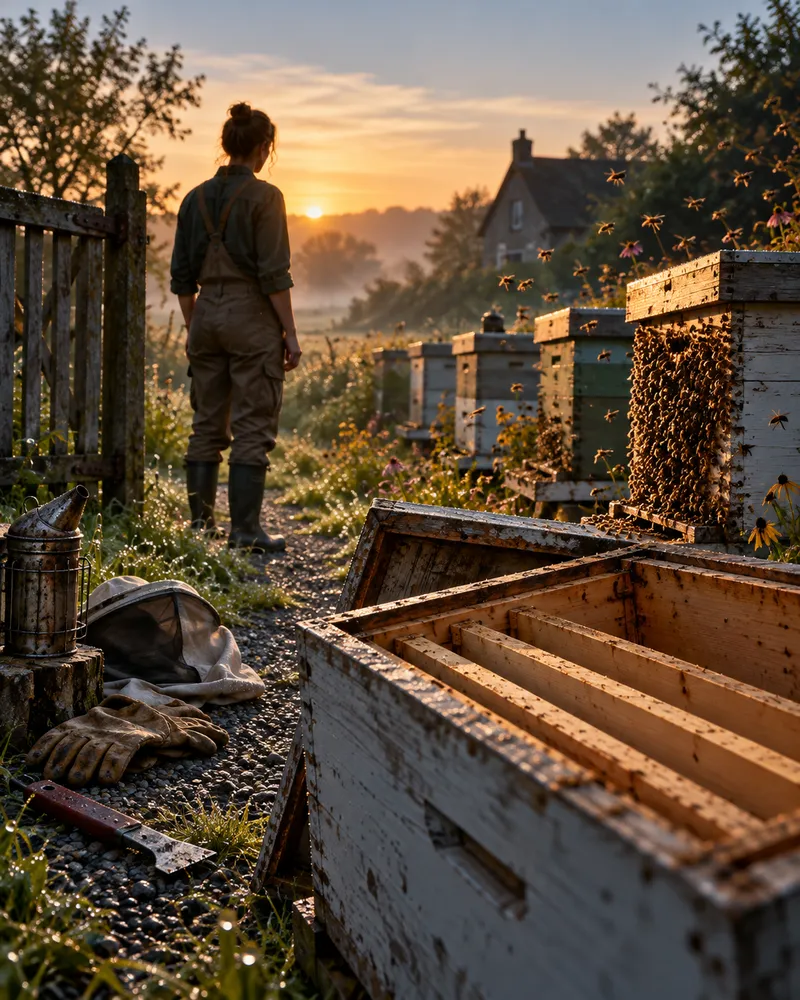
Maren Kessler walked the gravel path at six in the morning, her boots crunching through a layer of silver dew. Usually, this was the hour Doss Farrow greeted her with a steaming thermos and a grumble about his aching joints. But today, his garden gate swung open on a rusted hinge, and the air held a heavy, expectant silence. As she approached her twelve hives, she noticed that half of them were humming with vibrant life, while the other half were utterly silent. There was no golden roar, no scent of warm wax—just the sight of bare, pale wood where a colony should have been.
The Empty Comb
Maren called out to Doss as she passed his cottage, but her voice drifted into the morning mist without an answer. His garden gate stood open and wide. She paused by his vegetable patch, noting that his watering can sat full and heavy on the soil, its spout still dripping. The bench where he spent his afternoons reading was wet with dew, untouched since the previous evening. Doss was a man of rigid habits; he didn’t simply forget to water his tomatoes or leave his gate swinging in the breeze.
When she reached the apiary, the same unsettling feeling settled in her chest. Twelve hives sat in two neat rows beside the old brickworks. Maren lifted the lid of the first hive and was immediately enveloped by a golden roar of activity. The bees were thick, their wings vibrating in a frantic, healthy hum that warmed the air around them. She moved through the first row—six boxes, all thriving, smelling of sweet nectar and warm wax.
Then she reached the seventh hive. She lifted the lid, expecting the same chaos, but found only silence.
She peered inside. The hive was bare. There were no bees clustering on the frames, no golden honeycombs dripping with syrup, not even a stray worker bee circling the rim. The wooden frame slots were clean and pale. Maren moved to the eighth, then the ninth, through to the twelfth. All six hives in the second row were empty. They didn’t look like they had swarmed—which usually leaves behind plenty of wax and honey for the remaining bees—they looked as if they had been dismantled.
Pell Wren was sitting on the tailgate of his rusted pickup truck, sipping from a thermos. He had been Maren’s seasonal helper for three weeks, a man of quiet efficiency and steady hands. He watched her with a calm, neutral expression.
“Partial swarm,” Pell said, his voice smooth. “Six took off, six stayed. It happens in late spring when the nectar flow hits unevenly across the valley. You get a split yard.”
Maren looked at the empty boxes, then back at him. “A partial swarm? But Pell, there’s nothing left in these boxes. No wax, no brood, not even a bit of propolis on the walls. A swarm leaves a home behind; it doesn’t take the house with it.”
Pell shrugged, his eyes scanning the horizon. “The colonies were probably over-crowded. They took everything they needed to start fresh.”
Maren shifted her gaze toward Doss’s cottage. “Where is Doss? He should have been here by now.”
“He left a note on the gate,” Pell replied, though he didn’t move from the truck. “Said he was finally moving to his sister’s place in Carrowbridge. Said he was done with the garden and the noise of the bees.”
Maren looked back at Doss’s open gate. There was no note. The gate was just a gap in the fence, swaying slightly. She didn’t tell Pell this immediately. Instead, she walked toward the gravel path that led away from the apiary toward the disused brickworks.
The mud was soft, having absorbed a heavy rain two nights ago. As she stepped off the gravel, she saw them: deep, parallel ruts in the earth. Two wheel tracks, about eighteen inches apart, carved into the dark soil. They were fresh—the edges of the mud hadn’t yet crusted over in the morning sun.
Beside the same path, Maren spotted Doss’s tools. His hive tool, his dented smoker, and his frame grabber weren’t tossed haphazardly; they were laid out in a perfect line on the gravel. It looked as though someone had carefully set them down to make room for something else.
The six full hives hummed behind her, but the silence of the empty ones felt heavier. It wasn’t the silence of a natural event. It was the silence of a room after someone had moved out and wiped the shelves clean. Maren stood in the mud, looking at the tracks leading toward the kiln buildings, wondering why Pell’s story didn’t match the ground beneath her feet.
No Queen’s Scent
Maren knelt beside one of the empty hives, sliding her hive tool under the edge of the inner cover. She didn’t just look this time; she investigated. As she pulled back the remaining wood, she realized the frames weren’t just gone—the slots where they had sat were sanded smooth. There was no sticky residue of propolis, that resinous bee-glue that usually coats every inch of a hive. The walls were pale and clean, as if someone had taken a scrub brush to the interior.
She pressed her face close to the wood and inhaled deeply. A healthy colony smells like a living thing: a mixture of warm wax, pungent propolis, and the sweet, floral scent of incoming nectar. But these hives smelled of nothing but fresh sawdust and dry timber.
“Pell,” Maren called out, “come look at this.”
Pell stepped off the tailgate, his movements fluid and slow. He leaned over the hive with her. “Still looks like a swarm to me,” he said, though his voice lacked its earlier certainty.
Maren ignored him and moved to one of the full hives. She pulled out a frame of brood, checking for the queen’s scent—that rich, pheromonal musk that tells the colony everything is under control. The bees were agitated, circling her hand in frantic loops. As she looked at the larvae, she realized something was wrong. The frames were thin. The bees had lost their most productive brood cells. They weren’t queenless, but they were confused, as if a vital part of their family had been plucked away while they slept.
She walked back to the gravel path and knelt by Doss’s tools. She picked up his hive tool. The flat end was worn smooth from twelve years of prying apart stubborn combs. He hadn’t just dropped it; he had placed it with intention. Beside it, the smoker sat ready, its bell slightly bent from a decade of use.
“Doss wouldn’t just leave his tools,” Maren whispered. “He treats these things like gold.”
She looked at the mud again. The wheel tracks were still the most compelling piece of evidence. They led straight toward the brickworks loading bay, deep and heavy, suggesting the trailer had been carrying a significant load.
Maren stood up and looked at Pell. He was standing with his hands shoved deep into his pockets. “Show me your hands,” she commanded.
Pell hesitated, then slowly withdrew them. His hands were remarkably clean. The nails were trimmed short, and the skin was smooth. There were no stings on his knuckles, no yellow pollen under his fingertips, and not a single smudge of sticky propolis on his palms.
“You’ve been working these hives for three weeks,” Maren said. “You’ve opened every box, handled every frame, and managed the splits. Where is the wax? Where are the stings?”
Pell looked at his hands as if seeing them for the first time. “I washed them,” he replied simply. “I like to keep things tidy.”
“Beekeeping isn’t a tidy business, Pell. Even with a smoker and a suit, you end up covered in the colony.”
She looked down at his boots. They were leather work boots, polished and dry. She compared the tread of his soles to the deep ruts in the mud. The patterns didn’t match. The tracks in the mud were wider, deeper, and belonged to a different size boot entirely—one that matched Doss’s heavy-set stride.
Maren picked up Doss’s hive tool and gripped it tight. The silence of the empty hives began to feel like a question. A man who has worked with bees for three weeks should smell like them. Pell Wren smelled only of peppermint and soap.
The Missing Brood
Maren climbed into her old Land Rover, the engine turning over with a guttural roar that echoed through the valley. She drove slowly toward the edge of the brickworks, following the twin ruts in the mud. The gravel road ended where the grass grew long and wild, interspersed with shards of broken red kiln bricks.
The tracks curved around the towering ruins of the old kilns, passing a collapsed coal store before straightening out toward the loading bay. Maren parked the truck and stepped into the soft earth. She walked the path of the wheels, noticing that in some places, the mud had been squeezed upward, indicating that the trailer hadn’t been empty. It had been heavy—heavy enough to sink three inches into the soil.
She stopped at the loading bay, a concrete slab where trucks once waited to take bricks to the city. She didn’t go further yet; she wanted to be sure of her deduction first. She drove back to the apiary and approached Doss’s favorite hive—a small eight-frame box he used for his personal hobby colony.
Maren lifted the lid. The frame slots were empty, but as she ran her finger along the top rail, she felt the smoothness of sanded wood. It wasn’t just a clean break; it was a preparation.
“He didn’t take the bees,” Maren realized aloud. “He took the brood.”
The realization hit her with a jolt. Pell hadn’t let the colonies swarm; he had harvested them. He had taken the frames filled with fertilized eggs and larvae—the most valuable part of the hive—leaving the worker bees behind to maintain the rest of the yard. It was a strategic theft, designed to maximize gain while minimizing the visible loss.
Maren thought of Doss’s tools lying in a line on the gravel. Doss was a man who noticed everything. He probably walked out to the apiary last night, saw Pell stripping the hives, and stepped forward to ask what was happening.
She pulled her phone from her pocket and dialed Doss’s sister in Carrowbridge. The line rang four times before going to voicemail. Maren frowned. Doss and his sister spoke every single morning at seven o’clock. It was now nearly eight.
“It’s Maren,” she said into the receiver. “I need to talk to Doss. He’s not at home, and something is wrong at the apiary. Call me back as soon as you get this.”
She lowered the phone and looked at Pell. He was still there, leaning against his truck, watching her with an expression of mild curiosity. He looked like a man waiting for a bus, but Maren could see the tension in his shoulders.
She realized that Pell wasn’t just her helper; he was currently the owner of six of her best colonies. And if Doss had witnessed the theft, then Doss was no longer just a neighbour—he was a witness who needed to be managed.
Maren looked at her own hands. They were stained with dirt and smelling of pine needles. She had spent three weeks trusting Pell’s competence, letting him handle the heavy lifting while she oversaw the season. Now, looking at the sanded wood of the empty hives, she realized that her trust had been the very thing that gave Pell the access he needed to steal.
Pell’s Hands
Maren walked back toward the pickup truck. She didn’t rush; she wanted Pell to feel her approach. When she reached him, she stopped exactly three feet away, forcing him to look up from his thermos.
“Show me your hands again,” she said.
Pell sighed and held them out. They were still pristine—pale, smooth, and devoid of any bee-related debris.
“You’ve been here for twenty-one days, Pell,” Maren said, her voice steady. “In those three weeks, you’ve handled hundreds of frames. You’ve fought with stubborn propolis and calmed angry swarms. But your hands are clean. Your boots are dry. And the mud in the valley is screaming that someone was here last night with a trailer.”
Pell didn’t flinch. He lowered his hands back into his pockets. “I told you, Maren. It was a partial swarm. I just happened to be here when it occurred.”
“A swarm doesn’t sand the wood,” Maren countered. “A swarm doesn’t leave Doss’s tools in a perfect line on the gravel. And a swarm certainly doesn’t make a man like Doss Farrow disappear without leaving a note for his sister.”
Pell finally shifted his weight, his gaze drifting toward the brickworks. “Maybe he just needed some air,” Pell suggested. “Doss is old. He gets restless.”
“He was watering his tomatoes last night,” Maren said. “He wouldn’t have left the watering can full if he were going for a stroll.”
The phone in her pocket buzzed. It was Doss’s sister calling back. Maren answered on the first ring.
“Maren! Is everything alright?” her sister’s voice sounded anxious. “Doss hasn’t called me yet. He always calls at seven. I tried him three times, but he didn’t answer his house phone.”
Maren looked at Pell. A small crease appeared between his brows, and his jaw tightened.
“He’s alright, Sarah,” Maren said, though she wasn’t entirely sure yet. “But I think he’s still nearby. I’m going to go find him.”
She hung up and looked at Pell. He was no longer leaning casually against the truck; he had straightened up, his eyes locked on Maren’s face.
“I’m going to the brickworks,” Maren announced.
Pell didn’t argue. He didn’t offer to come along or ask why. He simply stood there as Maren turned and climbed back into her Land Rover. As she shifted into gear and began to roll down the gravel path, she glanced in the rearview mirror.
Pell hadn’t stayed behind. He had climbed into his own truck and was following her, keeping a distance of about two hundred yards. He wasn’t rushing to catch up, nor was he falling behind. He was tracking her.
As the Land Rover bounced over the uneven ground toward the ruins of the kiln, Maren felt a prickle of heat on the back of her neck. Pell knew exactly where she was going because he had been the one to drive the trailer there. He wasn’t just following her; he was escorting her to the evidence.
The brickworks appeared through the mist—the hulking shadows of the kilns and the grey expanse of the loading bay. Maren slowed the truck, her eyes searching for the canvas-covered shape she had seen earlier. There it was: a small flatbed trailer parked at the edge of the field, tucked against the side of the old coal store.
What the Mud Remembers
Maren parked the Land Rover and stepped out into the damp grass. The air here smelled of wet stone and old soot. The trailer was a rusted, small-framed thing with a heavy canvas cover tied down at the corners. It sat motionless in the mud, looking like a grey, canvas-topped box.
Maren stopped ten feet from the trailer. Her heart hammered against her ribs. She thought about Pell, who was now parking his truck behind her, and she wondered if Doss was still inside that box.
She took a tentative step forward. From beneath the canvas came a sound—a soft, wet cough, followed by the heavy sigh of a man trying to find his breath.
Maren reached for the canvas tie. Her fingers were shaking slightly as she pulled the knot loose and flipped back the heavy fabric. Inside, sitting on a wooden bench with a wool blanket draped over his legs, was Doss Farrow.
His face was a pale, weathered grey, and his eyes looked slightly glazed, but when he saw Maren, they sharpened. He wasn’t tied down or locked in; he had been confined by the walls of the trailer and the weight of the canvas overhead.
“Maren?” he whispered, his voice raspy. “Is that you?”
“I’m here, Doss. You’re okay.”
Doss tried to sit up straighter, but his movements were fragmented and slow. “I was in the garden,” he said, his words tumbling out in a confused rush. “Watering the tomatoes. Then I saw the lights over at your place. The apiary. I walked over to see what the fuss was… then there was the smell. The smoker. That sharp, sweet smoke.”
He paused, frowning as if trying to retrieve a lost memory. “The sound of the tool on the wood—that clink-scrape sound. Then something heavy hit my shoulder. Not hard, just enough to push me down. And then… dark. I woke up in here. I don’t know how long I’ve been in this box.”
Maren looked past Doss toward the back of the trailer. There, stacked neatly beside the bench, were six wooden hive boxes. She leaned over and peered inside one of them. The frames were crowded with bees, their golden bodies clustering together for warmth. These were her missing colonies—the brood frames Pell had stolen. They were humming softly, a low vibration that Maren could feel in her own chest.
The theft was no longer a theory; it was sitting right there in the mud.
Suddenly, the crunch of gravel sounded behind her. Maren turned to see Pell standing at the edge of the field. He hadn’t rushed forward; he had walked with his usual, measured pace. His hands were back in his pockets, but his shoulders were hunched, as if he were bracing for a blow.
“Maren,” he said softly. “Let’s talk.”
He stood about ten feet away, the distance between the beekeeper and the thief. Between them lay the evidence: a confused old man, six stolen colonies of bees, and the soft, forgiving mud that had recorded every move Pell had made during the night.
The Dismantling
Pell stopped moving, his gaze shifting from Maren to Doss. He didn’t look guilty so much as he looked practical. He approached the situation the way he approached a hive: with patience and a clear objective.
“I needed the frames,” Pell explained, his voice calm. “The larvae were peaking. I had buyers lined up in the next town over—three different apiaries that needed a jumpstart. It was a good arrangement.”
“You didn’t just take the bees, Pell,” Maren said, her voice gaining strength. “You put my neighbour in a box.”
Pell shrugged slightly. “Doss is a stubborn man. He saw me working last night. He started asking questions—too many questions. I didn’t want to argue with him while I was hauling frames, so I put him somewhere he’d stop following me. He isn’t hurt. He’s just… staying put.”
“He’s sixty-five years old,” Maren countered. “And you left him in a trailer behind a kiln.”
Pell stepped closer. The distance between them closed to six feet, then five. He reached out and rested his hand on the edge of the canvas cover. It wasn’t an aggressive move, but it was a claim. His hand felt like a weight, a reminder that he was physically stronger than Maren.
“You should sit down, Maren,” Pell said. The calmness was still there, but now there was a sliver of something predatory beneath it.
Maren didn’t move. Instead, she stepped back toward the trailer and pulled her phone from her pocket, holding it high so he could see the screen.
“I’m dialling,” Maren said clearly. “You are ten feet from me. The frames are right here in this trailer. I can describe every single comb to a police officer—the brood cycle, the honey patterns, the specific way my hives were dismantled. I’ve kept records for twelve years, Pell. These bees aren’t just ‘bees.’ They are my bees. They will match my records perfectly.”
Pell didn’t back off immediately. He took one more step forward, his hand moving from the canvas to the trailer door, almost as if he were considering closing it again—or perhaps pulling Maren toward him. He tested her with a narrow-eyed stare, weighing whether she was bluffing.
“Or,” Maren continued, her voice unwavering, “you walk away. Right now. You leave the frames here, and you let Doss go home. I won’t call the police. You can find another job in the next town, and we will act as if this morning never happened.”
A long silence stretched between them. The only sounds were the low hum of the bees in the boxes and the distant whistle of wind through the brickworks ruins. Doss watched them from his bench, his eyes wide.
Pell let out a slow breath. He released his grip on the trailer and stepped back. “You’re a fair woman, Maren,” he said.
He turned without another word and walked back to his truck. He climbed in, started the engine, and drove away. The gravel crunched beneath his tires, and as he disappeared down the road, a cloud of dust settled over the field.
Maren exhaled, her shoulders finally dropping. She stepped into the trailer and reached for Doss’s hand. “Come on,” she said softly. “Let’s go home.”
The Hum Returns
The return to the apiary was a slow, rhythmic process. Maren and Doss worked together, carrying the brood frames from the trailer back to their original boxes. One by one, they slid the golden combs back into the sanded slots. As each frame clicked into place, the bees began to settle, sensing the familiar architecture of their home.
The hum returned to the yard, growing from a scattered murmur into a deep, resonant roar. The smell of warm wax and honey filled the air once more, erasing the scent of sawdust and damp earth. By the time the twelfth hive was closed, the apiary felt whole again.
Doss walked back to his cottage with Maren’s help, his gait still a bit unsteady. Once they reached his porch, Maren brewed two cups of coffee. She handed one to Doss, who sat on his wooden bench and gripped the mug with both hands. He didn’t drink immediately; he simply let the steam warm his face, his knuckles white against the ceramic.
“You’re okay now, Doss,” Maren said softly. “You’re home.”
Doss looked at her, a small, shaky smile appearing through his beard. “I am,” he whispered.
“I found us,” she added, thinking of the bees and the man.
Doss stood up slowly and walked to his vegetable patch. He picked up the watering can that had been sitting full since the previous evening. With trembling hands, he began to water his tomatoes, the water splashing rhythmically onto the dark soil. He was returning to the thing he had been doing before the smoker, before the darkness, and before the confinement of the canvas box.
Maren watched him for a moment, then walked back toward her hives. She stood in the center of the yard and closed her eyes, listening to the bees. The season had been saved, but as she looked at her own hands, she noticed they were clean. There was no propolis under her nails, no golden pollen on her skin.
She realized that while the bees were back, a certain silence remained. She had let Pell go. She hadn’t called the police or demanded an apology; she had simply traded a thief for her peace.
The cost of that decision was a new kind of caution. Maren knew now that trust was not a permanent state, but something that had to be verified with evidence. She would have to find a new helper for the late summer harvest, and when she did, she wouldn’t just listen to their words. She would watch their hands. She would check their boots. She would look at the mud.
Maren picked up her hive tool and opened one of the boxes. The bees surged upward in a warm, vibrating wave. She reached in and touched a frame of brood, feeling the heat of the developing larvae beneath her fingertips.
She breathed deeply, smelling the sweetness of the nectar and the richness of the wax. The comb was no longer empty. The hum had replaced the silence. But as she stood there, she felt the quiet space between the humming bees and her own breathing—the lingering knowledge of what had been lost and recovered.
Maren closed the lid on the hive. Her hands were clean, but they were ready for the next season.