Adventure · Saturday
Hauling the Thaw
Warm air promises a passage beyond the known cave. When the way back collapses, a rescue instructor and her injured trainee face a climb neither can complete alone.
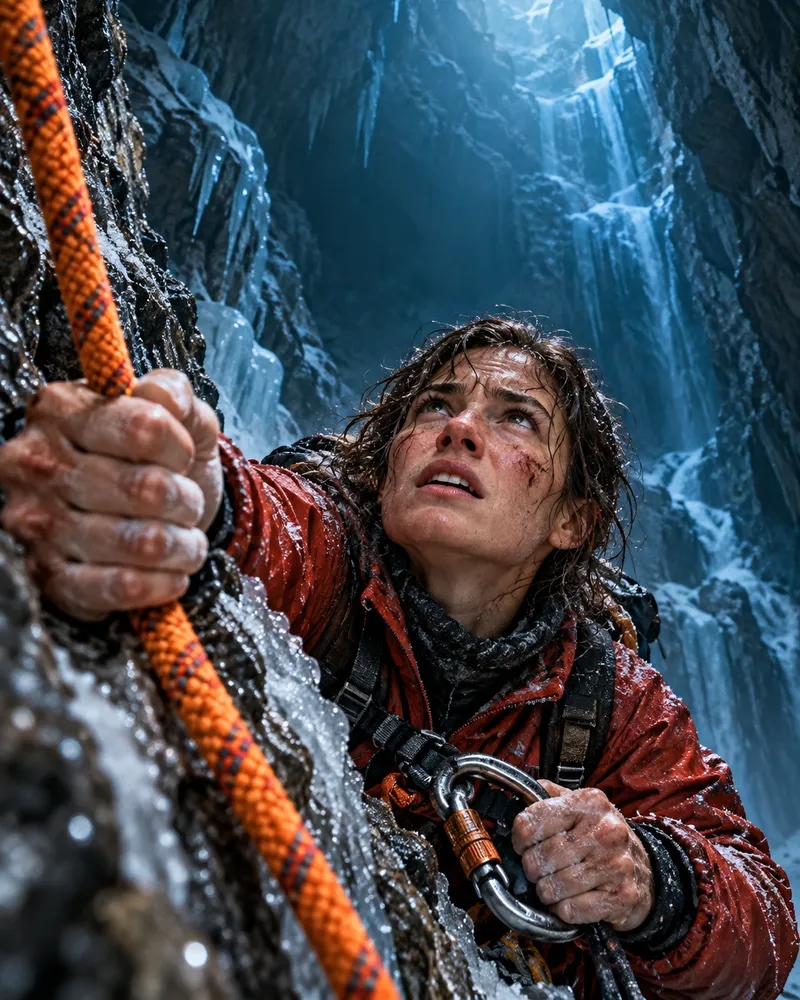
“Check your lock, Sable.” Maren Kessler’s voice echoed through the dry limestone gallery, steady and rhythmic. Beside her, Sable Oduya was focused on a carabiner, her fingers working with a precision that spoke of two years of hard training. They were deep in the belly of the Ilver Plateau, surrounded by the scent of damp stone and cold minerals. Then, the air shifted. A warm draught brushed against their necks, smelling of wet earth and crushed wildflowers. It was an invitation to explore. In eleven seconds, Maren made the decision to leave the safety of the known path and follow that warmth into the dark, not knowing the mountain was already preparing to trap them.
Sweet Air
“Crimp it tight,” Maren commanded.
Sable nodded, her fingers locking the carabiner with a sharp metallic click. They were mid-drill in the lower gallery of the Ilver Plateau system. For Maren, this was routine; for Sable, it was an exercise in precision. The cave air was typically a constant, chilly damp, but as they stood there, a sudden draught hit them from a narrow opening to their left. It was warm—almost tropical—and carried a sweet, mineral fragrance that smelled of deep earth and hidden water.
Maren stopped. She looked at the narrow passage, then back at the way they had come. “Hold position,” she told Sable. “We’re investigating.”
Maren stepped into the Warm Vein first. The passage was tight, forcing her to turn her shoulders to fit through the limestone walls. As she moved deeper, the temperature rose. The stone felt like polished silk under her palms, and the air grew heavier, humid enough to dampen her skin. She traveled thirty metres in, then called back, “Come in, Sable!”
Sable followed, her boots crunching on a fine layer of calcite dust. They were deep in the vein when the world shuddered. A low hum vibrated through the soles of their boots, escalating into a thunderous roar that seemed to swallow the silence of the cave.
A sound like a giant bone snapping rolled through the limestone. Maren spun around just as a cascade of rock hammered into the passage they had just exited. The return gallery had failed. “The ceiling was thinner,” Maren noted, her voice tight. “The ice got in the cracks overnight. That’s all it takes.”
A sudden jolt threw Sable sideways. She gasped as her right arm slammed against a jagged limestone ledge. There was a sharp crack, followed by the dull thud of her body hitting the floor.
Maren rushed to her side. Sable was clutching her right wrist, which now sat at a crooked, sickening angle. The trainee’s face was pale, but her jaw was set.
“Let me see it,” Maren said.
Sable pulled back slightly, her eyes flashing. “It’s fine.”
“It is not fine, Sable. Your wrist is snapped.”
Maren worked quickly. She pulled a length of nylon webbing and a heavy-duty carabiner from her harness. With methodical precision, she wrapped the webbing around Sable’s forearm and wrist, using the carabiner to lock the splint in place against her arm. The fabric bit into the skin, stabilizing the fracture.
Sable breathed through her teeth, staring at the rubble field that now blocked their path home. The return route was gone, replaced by a wall of grey boulders and fine silt.
“Okay,” Maren said, looking deeper into the Warm Vein. “We find another way out.”
Sable looked at the debris, then at her splinted arm. “There is no other way out.”
Maren tightened her grip on her headlamp. “Then we make one.”
The Throat
They pushed deeper into the Warm Vein for twenty minutes, navigating low ceilings and sudden dips. The air remained humid, but the passage began to tilt upward. Eventually, the vein opened into a small chamber where the walls vanished, replaced by a vertical slot that soared toward the ceiling.
Maren stepped to the edge and looked up. “Forty metres,” she estimated. “Maybe more.”
Her headlamp beam sliced through the dark, revealing a rough-hewn shaft of limestone. It was pitted and spalling, with flakes of rock the size of dinner plates hanging by crystalline bridges. The light traveled upward until it hit a distant, dark opening that leaked a sliver of grey light.
Maren reached for her rope—a single thirty-metre length of static nylon. She fed the end of it up into the shaft. It fell with a rhythmic slap-slap-slap against the wall before coming to a halt.
She pulled it back down. The rope was ten metres short of the opening.
Maren checked her watch: 14:02. She did the mental arithmetic. “Forty metres to the top, thirty-metre rope,” she said. “We have to do this in three stages.”
Sable sat on a flat ledge at the base of the shaft, her right wrist resting against her chest. The webbing splint was already beginning to soak through with dark red blood where the fracture had been most severe.
“Hand,” Maren commanded.
Sable extended her arm. The swelling had increased, making the skin tight and glossy. Maren adjusted the tension on the webbing, ensuring the wrist was locked but not strangled. Above them, a faint, wet grinding sound echoed from the walls—the sound of water wicking through the plateau above and freezing in the cracks, then melting again.
Maren reached into her gear bag and pulled out a cam. She jammed it into a vertical fissure in the wall of the shaft and clipped a quickdraw to it. She tugged hard, testing the anchor with her full weight. It held.
“Three stages,” Maren explained. “I climb first. You haul me up. Then you climb up to meet me. We repeat.”
Sable looked at her broken wrist. “One-handed?”
“One-handed,” Maren confirmed.
“And I’m climbing up every time?”
“And you’re climbing up every time.”
Maren stepped into the harness. The clock was ticking; if they didn’t move, the thaw would make the shaft increasingly unstable. By her estimate, they had five hours before the window of escape became dangerously narrow.
First Haul
Maren rigged the first hauling point with a cam in a narrow crack and a prusik loop—a friction knot—around the main rope. With a surge of effort, she climbed eight metres up to a small limestone shelf, barely wider than her boot. There, she rigged a second anchor.
She fed the slack back down to Sable.
On the floor of the shaft, Sable faced the first real test. She couldn’t use her right hand to grip, so she slid the prusik loop under her left armpit. She used her body weight to hold the tension against the rope while her fingers worked the wrap. The nylon cord bit into her shoulder, a dull ache that she ignored for the sake of stability.
She clipped the hauler and began to pull.
Maren hung from the first point, then transitioned her weight to the second anchor. As Sable hauled, Maren felt herself being dragged upward in rhythmic, jerky increments. Every metre was a negotiation between the friction of the prusik and the strength of Sable’s left arm.
“Crimp. Lock. Breathe. Belay,” Maren called down.
Sable didn’t breathe; she grunted. Her left hand gripped the rope with white-knuckled intensity, her forearm muscles bulging. When Maren finally reached the ledge and clipped in, Sable let out a long, shuddering exhale.
Now came the ascent.
Sable clipped her safety line to the main rope and looked up at the eight-metre gap. She placed her left boot on a jagged hold and pulled. Her right arm remained dead weight, swinging like a pendulum as she hauled herself upward in jagged increments. She didn’t look down; she focused entirely on the next handhold.
She reached up with her left hand, found a grip, pulled her body upward, and stepped her feet up to follow. When Sable finally reached the ledge, she clipped into the anchor and sat back against the cold stone.
“Next,” she said.
Maren checked her watch: 15:10. They had spent sixty-eight minutes on the first eight metres. The thaw sound had grown louder, a rhythmic dripping now accompanying the grinding of the rock. The light at the top was no longer just a hole; it was a thin, pale grey line.
“Two more stages,” Maren said.
Sable looked up at the remaining distance. “And I’m still climbing.”
“You’re still climbing,” Maren replied.
Spall
The second stage was a test of nerves. Maren climbed from the first ledge to a second anchor point twelve metres above. Here, the rock was more treacherous—honeycombed and pitted, with thin plates of limestone hanging like frozen curtains.
As Maren clipped her second anchor, a sudden crack echoed through the shaft. A plate of stone the size of a laptop sheared off the wall above her and slammed into the rope. The impact sent a shockwave down the line, jerking Maren violently against the wall.
Below, Sable felt the jolt travel through her arm. She locked her left hand around the rope instantly, her muscles snapping taut to prevent Maren from swinging too far.
“I’ve got it!” Sable shouted, her voice flat and controlled.
Maren froze, checking her anchor. The cam held firm. Once she was stable, she fed the slack back down. Sable began the haul again, but this time, the resistance felt heavier. To gain more leverage, Sable leaned forward and bit the hauler’s metal handle between her teeth. This freed her left hand for two seconds to adjust the carabiner without losing tension on the line. She swallowed the cold, metallic taste of the gear, refusing to let go until the clip was secure.
They made the twelve metres, but as Sable reached the second ledge, a thin crystalline seal in the shaft wall gave way. A pocket of water trapped behind a calcite crust burst, and a torrent of ice-cold water poured into the lower part of the shaft.
The conditions changed instantly. The rope became slick; the air grew colder. Sable’s left hand was drenched.
“Sable, you’re wet!” Maren called down.
“I’m wet,” Sable replied.
“Can you still hold?”
Sable looked at the shimmering nylon. “Watch me.”
She re-wrapped the prusik with her left hand, her fingers slipping on the wet rope. The knot slid a few inches, nearly sending Maren dipping downward. Sable cursed, repositioned her grip, and tightened the wrap until it bit deep into the nylon.
Then came the climb. Twelve metres. One-handed. Wet.
Sable hauled herself up the wall, her left arm burning. The water made the holds slick, forcing her to dig her boots deeper into the limestone. Her right hand dangled, the webbing of her splint now a mixture of blood and cave water. She climbed through the spray until she finally reached Maren on the second ledge.
Maren checked her watch: 16:45. The grey light at the top had turned into a shimmering silver line.
“The last stage,” Maren said. “The longest one.”
The Squeeze
The third stage demanded twenty metres of verticality. As Maren climbed away from the second ledge, the shaft changed shape. The open air vanished, and the walls closed in until they formed a narrow slot barely wider than Maren’s shoulders.
This was the Squeeze.
Maren could no longer climb with fluidity. She had to force her body through the gap, pressing her chest against one wall and her back against the other. She moved in a slow compression: one hand on the rope for stability, one hand searching for a hold in the pitted rock, and feet scrabbling for purchase.
The walls were now coated in a thin film of water from the thaw. Maren felt herself sliding a few inches back with every move. The cold water seeped directly onto her face, an insult of ice that made her blink rapidly.
Twenty metres below, Sable was anchored to the second ledge. She held the rope taut, her left hand shaking from sustained effort. Suddenly, she felt a soft give—the prusik was slipping in the wetness.
“Sable, the prusik’s slipping!” Maren yelled.
“I’m tightening it!”
To tighten the knot one-handed, Sable reached for the carabiner on her harness and used it as a pivot point. She pulled the rope through the carabiner in a tight figure-eight, using her own body weight to lock the tension. The prusik bit back into the nylon with a satisfying snap.
Maren felt the line tighten and pushed upward. She forced her shoulders through the narrowest part of the Squeeze, her ribs pressing against the limestone. Her breath came in short, sharp bursts. As she finally emerged from the slot, the shaft opened up again, and the silver light grew wider.
Maren looked down at Sable, who was still twenty metres below, a small but fierce figure clinging to the rock.
“I’m through!” Maren called. “The Squeeze is behind me!”
“I can see the light!” Sable replied.
“Then hold,” Maren commanded. “Hold everything you’ve got.”
Sable locked her arm, her muscles vibrating with tension. She became the anchor for both of them, a single point of strength in the damp dark. Maren reached upward, her fingers grazing the final stretch of rock. The water was now running in thin ribbons down the walls, turning the limestone into a vertical river.
The Last Two
Maren reached the lip of the shaft. She was nearly out, her head already bathed in the dim, grey light of the plateau. But as she gripped the edge, she realized the danger had shifted. The final two metres weren’t about height; they were about structural integrity.
The lip of the shaft wasn’t a solid ledge; it was a crumbling shelf of broken stone held together by dissolving crystalline bridges. As Maren pulled herself up, the rock beneath her fingertips began to give way.
She gripped a protrusion and pulled. A flake of limestone the size of a thumbnail snapped off and vanished into the dark. She shifted her weight and pulled again; this time, a piece the size of her palm sheared away.
The stone sounded like a biscuit crumbling under pressure. Maren wasn’t just climbing; she was pulling against an edge that was actively failing.
“Sable! Haul!” Maren shouted.
“Hauling!” Sable yelled back from the second ledge, twenty metres below.
Sable gave one final, explosive pull, her left arm straining until the muscle felt like it might tear. The rope tightened, lifting Maren’s torso upward and reducing the pressure on the crumbling lip.
Maren lunged forward, her fingers digging into a slightly more stable vein of rock. She pulled with everything she had, feeling a chunk of stone the size of a fist break away from under her boot. For a heartbeat, she teetered on the edge, half-in and half-out of the earth. Then, with one final heave, she rolled onto the flat surface of the plateau.
The cold air hit her face like a physical blow. Thin, dry snow began to fall. Maren didn’t celebrate yet; she turned back to the hole in the ground.
Sable was still down there.
Maren braced herself on the edge and reached down, gripping the rope. Now it was Sable’s turn for the final ascent. The trainee began the long climb up from the second ledge—twenty metres of vertical rock, one-handed, with a raw palm and a blood-stained wrist.
Reach, pull, step. Reach, pull, step.
Sable climbed with a stubborn, grinding rhythm. Her right arm swung in time with her movements, the splint now a deep, dried crimson. As Sable reached the lip, her left hand searched for a grip. Maren leaned over the edge and reached down, her fingers locking around Sable’s forearm.
“Got you,” Maren whispered.
With a coordinated heave, Maren pulled Sable upward. The trainee scrambled onto the plateau, sliding across the limestone and landing in the soft, cold snow beside her instructor. They lay there for a moment, two small figures against the vast, grey expanse of the Ilver Plateau.
The Bothy
They didn’t linger by the shaft. The wind was picking up, whistling across the plateau and carrying a promise of heavier snow. Maren helped Sable to her feet, though the trainee insisted on walking herself. They moved slowly, their boots crunching through the fresh powder toward a small stone structure forty metres away: the bothy they had used as their base camp.
The bothy was a low, square hut made of stacked fieldstone with a heavy wooden door that stuck in the frame. As Maren pushed it open, a wave of stillness greeted them, shielding them from the biting wind.
Inside, they collapsed onto a wooden bench. The silence was thick. Maren’s hands were raw and shaking, her fingertips numb from gripping the crumbling lip of the shaft. Beside her, Sable sat with her wrist resting on her lap, the splint now tightened and secure.
They shared a single flask of water. The liquid was flat and cold. For several minutes, neither of them spoke, letting the exhaustion settle into their bones.
Sable looked at Maren, her eyes reflecting the quiet strength of the last few hours. “You should have told me the shaft was forty metres,” she said softly.
Maren let out a short, dry laugh and looked at the ceiling of the bothy. “I should have told you a lot of things.”
A beat of silence passed between them—a recognition of the risk Maren had taken when she decided to follow the warm draught, and the resilience Sable had shown in holding the line.
“Next time,” Sable said, her voice gaining a hint of its usual stubbornness, “I’m the one who finds the warm air.”
Maren didn’t smile, but she nodded slowly. She reached over and gave Sable’s shoulder a brief, firm squeeze.
Outside, the wind began to howl again, rattling the wooden door and swirling the snow against the stone walls. But inside, they were dry. They were warm. The door was closed. The wind came back.