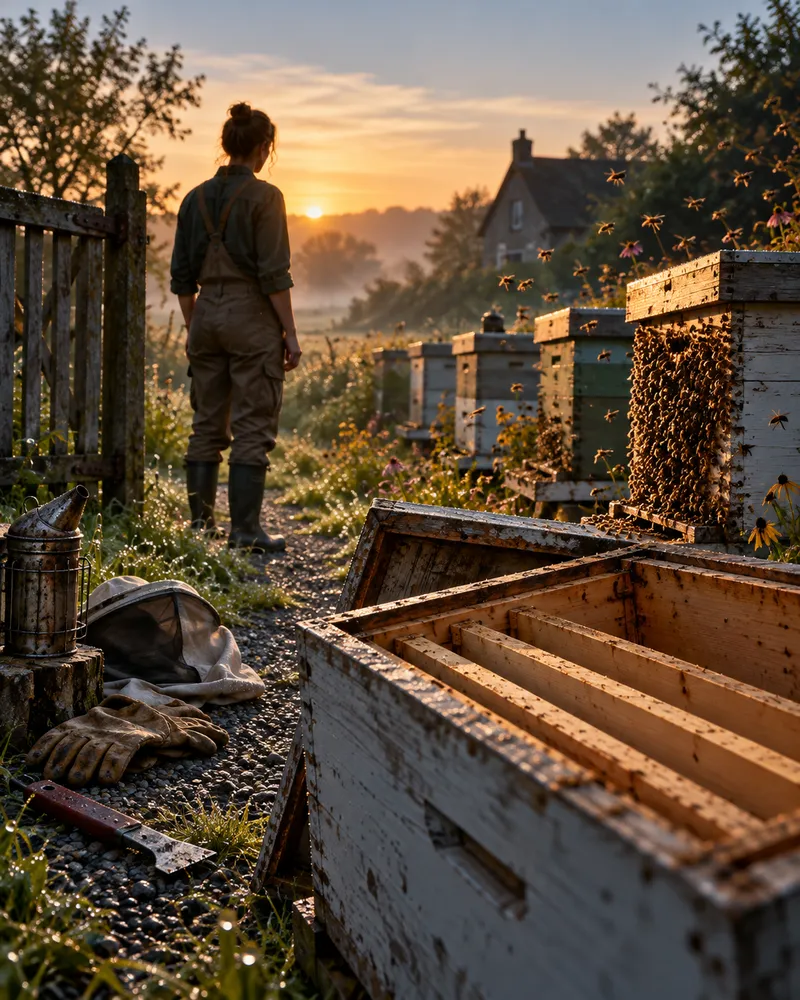
Mystery · Tuesday
The Plaster Marrow
The prize marrow has a plaster shell, and its grower wants a rival expelled. Before anyone loses their plot, the new secretary has a few awkward questions about the weigh-in.
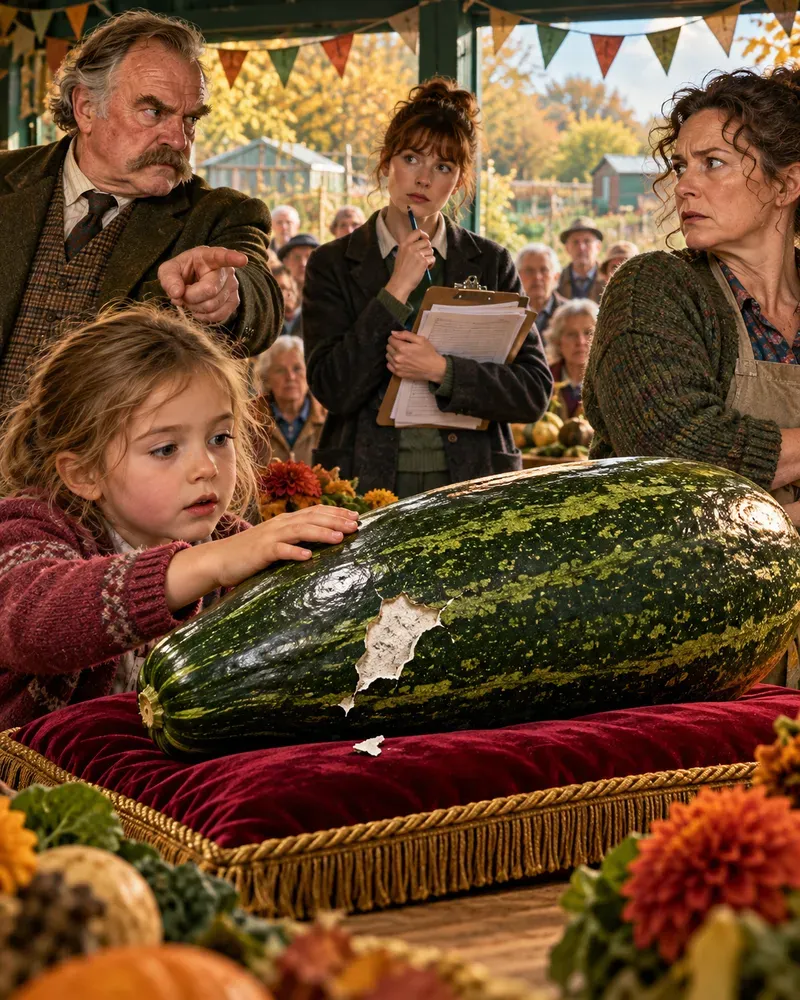
The autumn prizegiving at Kettlewell Allotments usually ends with polite applause and the scent of damp earth. But this year, twenty minutes after the trophies were handed out, a six-year-old girl reached out to touch the winning marrow. As her small palm pressed against the glossy green skin, a tiny, white flake curled away from the surface and drifted onto the velvet cushion. The pavilion went silent. Oswin Cragg, the nine-time champion, didn’t look at the flake; he looked straight at Tamsin Wray, the runner-up. “It’s yours, isn’t it?” he asked, his voice a low rumble of accusation. In the back row, Maren Foss held a stack of membership forms and a clipboard, the only person in the room who hadn’t yet decided who was lying.
The Flake
The show pavilion was a corrugated-iron structure that smelled of damp metal, buttery shortbread, and the sharp, green scent of oversized vegetables. A banner draped across the rafters proclaimed “KETTLEWELL ALLOTMENTS – GROWING TOGETHER SINCE 1962,” though the edges were fraying and a single bucket in the corner caught a rhythmic drip from a leak in the roof. Forty members crowded the space, their voices humming in a gentle chaos of tea-time chatter.
In the center of the room sat the display table. On it, resting on a royal blue velvet cushion, was Oswin Cragg’s winning marrow. It was a masterpiece of symmetry: long, heavy, and painted by nature in a deep, lustrous emerald. Tamsin Wray stood three rows behind him, carefully packing her own second-place entry—a slightly shorter, scarred vegetable—into a cardboard box.
Penny Sook’s granddaughter, Maya, escaped her mother’s grip and leaned over the table. She pressed her palm flat against the skin of Cragg’s marrow. There was no squish, no give. Instead, a small, papery flake of white plaster curled away from the green surface and landed softly on the velvet.
The room fell silent. The clink of tea cups stopped; the cake knife paused mid-slice.
Oswin Cragg turned slowly. He didn’t look at the flake. He looked at Tamsin Wray. “Tamsin,” he said, his voice quiet but heavy with implication. “That’s your work, isn’t it?”
Tamsin froze, her hands still gripping the edges of her cardboard box. Her face went pale, then flushed a deep red. “I made a replica for the Harvest Parade two weeks ago, Oswin. But I didn’t touch this.”
“Then explain the plaster,” Cragg replied. He didn’t shout; he simply let his words hang in the air like a challenge.
The committee members began to murmur. Penny Sook stepped forward, her brow furrowed. “It seems obvious,” she whispered. “Tamsin is a caster by trade. She had the materials right there in her shed.”
Maren Foss watched from the back row. As the new secretary, Maren was still viewed by most as a bit of a busybody—the woman who had spent her first three months reorganising the tool shed and insisting that everyone actually follow the bylaws. She stepped forward, clutching her clipboard to her chest.
“We’ll vote on the expulsion tomorrow,” Penny Sook announced, referring to the penalty for sabotage.
“I’d vote tonight if I could,” Cragg added, his eyes narrowing at Tamsin.
Maren opened her bylaws booklet, her finger tracing a line of text. “Clause 14, subsection C,” she read aloud, her voice steady and clear. “No member shall be expelled without a full evidentiary hearing and a minimum of twelve hours’ notice to the accused.” She looked at Tamsin, whose shoulders had slumped. “You have twelve hours, Tamsin.”
Maren stepped toward the display table. With two fingers, she carefully pinched the white flake from the blue velvet. It was light and brittle, far drier than any piece of a real vegetable. She pulled a small paper envelope from her pocket, dropped the flake inside, and sealed it with a precise fold. On the front, she wrote: Exhibit A – Kettlewell Autumn Show.
She held the envelope up for the room to see. “I am taking custody of this,” Maren announced. “It stays with me until the hearing.”
Cragg’s jaw tightened. He didn’t argue, but he didn’t smile either. He picked up his tweed coat and walked out of the pavilion, the heavy iron door banging shut behind him. The sound echoed through the room, leaving a lingering tension that felt as thick as the autumn mist outside.
Four Kilos, Exactly
The allotment office was a converted garden shed that smelled of old paper and cedarwood. A filing cabinet stood in the corner, its drawers humming with the history of the society, while a small window looked out onto the tool shed—now perfectly organised by Maren’s hand, with spades lined up by size and rakes hung by their heads.
Maren sat at her desk, opening the tin box that held the show records. She pulled out the weighing log, a carbon-copy sheet dated that morning. Her eyes jumped to the first entry: O. Cragg, Plot 7, Marrow, 4.00 kg, 7:42 AM.
She stared at the number. Then she looked at Tamsin’s entry: T. Wray, Plot 14, Marrow, 3.62 kg, 8:15 AM.
Maren leaned back in her chair and called out to Dot Fenwick, the society’s weigher, who was currently wiping her hands on a flour-dusted apron. “Dot, come here for a second.”
Dot approached tentatively. She was a small woman with kind eyes and a habit of glancing toward the door as if expecting Oswin Cragg to appear at any moment.
“Dot,” Maren said, pointing to the log. “How many marrows have you weighed in all your years here?”
“Hundreds, dear. Maybe thousands,” Dot replied.
“And how many of them weighed exactly four kilos? Not four-point-one, not three-point-nine, but exactly four point zero zero?”
Dot paused, her brow wrinkling. She looked at the page and then back at Maren. “None. Not one.” She laughed softly, a small, nervous sound. “They’re vegetables, Maren. They don’t come out even. Usually, it’s something messy like three-point-eighty-four or four-point-one-two.”
“And Cragg’s?” Maren asked.
“Four. Point. Zero. Zero,” Dot whispered. “I remember because I checked the scale twice. I actually thought the scale was stuck for a moment.” She paused, her expression turning thoughtful. “It felt different, too. When I lifted it, it was cold. Not just autumn-morning cold, but stone-cold. And it was heavier than it looked. When I set it down on the digital plate, the whole scale wobbled slightly.”
Maren scribbled a note on her clipboard: Weight is suspiciously precise. Texture: Cold/Stone.
“Was there anything else?” Maren asked.
Dot nodded eagerly. “Yes! Right as I was setting it down, a little white bit flaked off the stem. I brushed it away with my thumb and thought it was just some limestone dust from the soil.” Dot paused, her voice dropping. “Oswin told me not to talk about it. He said I was being ‘inaccurate’ when I mentioned the flake. He warned me that if I changed the record, there might be consequences for the council grant.”
“What kind of consequences?”
“He just said he could make things ‘difficult,’” Dot replied, her voice barely audible over the ticking of the cooling kettle on the stove. “He’s been on the allocation panel for years. He knows how to move the money.”
Maren looked at Dot and felt a surge of protectiveness. She reached out and patted the older woman’s hand. “Dot, you weighed a vegetable and wrote down four-point-zero-zero. That isn’t inaccurate. It is the most accurate record in the history of this show.”
Dot beamed, her posture straightening. Maren locked the tin box and stood up. The weight was the first clue, but it wasn’t proof yet. She needed a visual record. She needed Rex Halloway and his camera.
The Chip
Rex Halloway’s kitchen was located directly above his hardware shop on the high street. It was a room that smelled of Earl Grey tea and sawdust. Rex, a man who preferred the company of lenses to people, was currently pouring sugar into a mug of tea while explaining his reluctance to get involved in the “marrow madness.”
“I’m just the photographer, Maren,” he said, gesturing with the spoon toward his laptop. “I capture the truth; I don’t have to interpret it.”
Maren ignored his modesty and pointed to the screen. Rex had opened the official weighing photograph. In the image, Cragg’s marrow sat centered on the digital scale, Dot Fenwick’s hand steadying its side. The readout clearly showed 4.00 kg. Maren leaned in, zooming in on the stem of the vegetable. There, near the base, was a small, irregular chip—a crescent-shaped break in the glossy green skin that revealed a bright white interior.
Maren photographed the screen with her phone and then immediately walked three blocks down to Kettlewell Primary School.
In the school hall, Lottie Wray was sitting at a long trestle table with her classmates. In the corner of the room sat the Harvest Parade replica: a life-sized plaster marrow, painted a deep, shimmering green.
“Look!” Lottie shouted, running over to Maren. She pointed to the stem near the base of the plaster cast. “I dropped it when we were loading the float on Tuesday. See? It’s got a chip.”
Maren held her phone up next to the actual replica. She compared the crescent-shaped break in the photograph to the one on the same spot of the plaster marrow. They were identical. The shape, the position, and the stark white interior matched perfectly.
“I made this for Lottie’s class,” Tamsin said, arriving beside her daughter. “I painted it in my shed on Monday. I carried it here on Tuesday morning. It has been sitting in this hall since then.”
As they spoke, the school door creaked open and Oswin Cragg stepped inside. He didn’t look at Maren; he walked straight to the replica. He leaned down, squinting at the chip on the stem, his face a mask of concentration. He reached out as if to touch it, then pulled his hand back.
“Still here,” Cragg muttered, almost to himself. He looked up at Maren, his eyes sharp. “It’s a lovely piece, Tamsin. But surely you didn’t think this was the one on the table?”
“I know it wasn’t, Oswin,” Maren replied. “Because this one is right here.”
Maren looked at the replica, then back at her phone. A realization struck her: the object on the display table wasn’t Tamsin’s original replica. It was a cast of that replica. Someone had taken Tamsin’s work, created a mould around it, poured in new plaster, and painted it to look like a vegetable.
“The chip matches because the caster worked from the original,” Maren explained. “You didn’t swap your marrow for his, Tamsin. Someone swapped a copy of your marrow into his spot.”
Tamsin let out a long, shuddering breath. “So I didn’t do it.”
“Not only did you not do it,” Maren said, “but the evidence suggests that whoever did it used your art as their blueprint.” Cragg shifted his weight, glancing at the replica one last time before turning to leave, his expression unreadable.
The Lopsided One
Late afternoon cast long, amber shadows across Plot 7. Maren walked through the rows of marrows with her clipboard, performing a site inspection that she was officially three weeks behind on. The air was crisp, and the soil beneath her boots felt rich and damp.
As she reached the back of Cragg’s plot, she stopped. There, still clinging to the vine, was a marrow. It wasn’t the symmetrical trophy from the pavilion. This one was shorter, slightly curved, with a pale, yellowish patch where the sun had hit it unevenly on the north-east side.
Maren crouched down and estimated its size. “Three kilos, maybe,” she whispered. She noted it on her clipboard: Plot 7, one marrow remaining, approx. 3 kg, lopsided, pale patch NE side.
She stood up and walked toward Cragg’s shed. The door was propped open with a brick. Inside, the air smelled of wet earth and something chalky. Maren didn’t touch anything; she simply observed. On the workbench sat a half-empty bag of coarse grey sand, a roll of clear plastic wrap, and a small bucket with a crust of dried white residue clinging to the bottom.
“You’re doing the inspection,” a voice said from the doorway.
Maren turned. Oswin Cragg was standing there, his arms folded across his chest. He looked tired, the lines around his eyes deeper than they had been in the pavilion.
“I am,” Maren replied. “And I’m three weeks late.”
Cragg glanced at her clipboard and then at his shed. He stepped aside, gesturing for her to enter. “You can go in if you like. It’s an open shed.”
Maren stepped inside the small space. She pointed to the sand bag. “The sand was for ballast, wasn’t it? To make sure the cast weighed exactly four kilos?”
Cragg didn’t look at her. He looked at the bucket of dried plaster. “It was a display piece,” he said defensively. “A demonstration of form. I wanted to show the committee what a perfect marrow could look like.”
“But you entered it as a vegetable, Oswin,” Maren said softly. “You weighed it. You accepted the first-place ribbon.”
Cragg sighed, his shoulders dropping an inch. “I was ill that morning. I got confused between my entries. It was a mistake.”
Maren looked at him—really looked at him. She saw the sand, the plastic wrap used to seal the mould, and the bucket for mixing. This wasn’t a mistake; it was a process.
“You cast Tamsin’s replica,” Maren said. “You ballasted it with sand so it would be heavy enough to win. You wrapped it in plastic so the paint wouldn’t smudge during weighing. That isn’t a mistake, Oswin. That is a strategy.”
Cragg didn’t answer immediately. He looked out at his plot, where the lopsided marrow still sat on the vine. “You have a photograph and a bag of sand,” he said, his voice regaining some of its councillor-like authority. “But I have thirty-one years of membership. The committee knows me. They trust me.”
He turned and walked away down the gravel path, his boots crunching rhythmically. Maren stayed in the shed for a moment longer, looking at the residue in the bucket. She wrote one final line on her clipboard: Cast theory supported by fabrication materials. Real marrow remains on vine.
The Grant
Dusk settled over the allotments, turning the sky a bruised purple. Maren walked slowly through the rows of vegetables, her boots crunching on the gravel paths. She was checking the winter preparations—the mulch, the stakes, and the remaining marrows—while her mind raced through the evidence she had gathered.
As she passed the reorganized tool shed, her phone vibrated in her pocket. It was Oswin Cragg.
Maren stopped walking, standing in the middle of a row of darkening kale. She answered. He didn’t shout; his voice was a smooth, measured velvet that carried a hint of steel. “Maren. I’ve been thinking about the council grant for the allotments.”
Maren tightened her grip on her phone. “The grant?”
“I’ve sat on the allocation panel for nine years,” Cragg reminded her. “A small oversight in the paperwork, a missed deadline, or a form that doesn’t get signed—it can all happen so quickly. It’s not personal, of course. Just the way things work.” He paused, and Maren could hear him breathing on the other end. “Let the matter rest, Maren. Tamsin is young; she’ll recover from a second-place finish. But the society needs its funding.”
Maren looked around at the plots—some chaotic and wild, some precise and manicured. She thought about Dot’s nervous laughter and Tamsin’s white-knuckled calm.
“I understand, Oswin,” Maren said. “But I think the society also needs a secretary who can be trusted to find the truth.”
She hung up before he could respond. She felt a strange, steady hum of confidence in her chest. She wasn’t fighting with her voice; she was fighting with evidence.
As she reached the edge of the pavilion, the phone rang again. This time it was Penny Sook.
“Maren! I’m calling an emergency committee meeting for nine o’clock tomorrow morning,” Penny announced. “We need to save time and protect the society’s reputation. We can vote on Tamsin’s expulsion immediately.”
Maren stopped, looking up at the leaking roof of the pavilion. “The bylaws say the accused must be present and the evidence presented in full before a vote is taken, Penny.”
“True,” Sook replied, “but the bylaws also say the committee can act in the best interests of the society.”
“Clause 14, subsection D,” Maren countered instantly. “The ‘best interests’ specifically include the right of the accused to a hearing. I wrote that clause myself, Penny. You voted against it during the spring meeting because you thought it was too tedious.”
There was a long silence on the other end of the line. Penny Sook sighed. “You always did have a memory for the fine print, Maren. Fine. Nine o’clock tomorrow. Be there.”
Maren hung up and walked toward her home, passing the banner that read GROWING TOGETHER SINCE 1962. The world was cooling, but the conflict was just heating up.
The Hearing
The pavilion was packed at nine in the morning. Twelve committee members sat in a semi-circle of folding chairs. Tamsin Wray sat in the front row, her back straight and her hands folded neatly in her lap. Oswin Cragg stood in the back, arms crossed, his coat draped over one arm like a shield.
Maren stood at the front, holding her manila folder. Rex Halloway was beside her, his laptop open and ready to project images onto the corrugated iron wall.
Maren didn’t give a speech; she presented a sequence of proofs. She paused after each point, allowing the silence to let the evidence sink in.
First, she held up the weighing log. “Four point zero zero kilograms,” she announced. “In thirty years of showing, we have almost never seen a marrow weigh exactly four kilos. Vegetables are irregular. This was precise.”
Second, Dot Fenwick stood up. Her voice was small but clear. “The vegetable was stone-cold,” Dot testified. “It was heavier than it looked. When I set it down, the scale wobbled, and a white flake came off the stem. I wrote four-point-zero-zero because that is exactly what the scale said.”
Cragg shifted in the back. “You are misremembering, Dot,” he said softly. “You’ve done this for twenty years; you’re simply imagining the flake.”
“I am not imagining it, Oswin,” Dot replied, her voice strengthening. “I remember it because I brushed it away with my thumb.”
Third, Rex pressed a key on his laptop. The photograph of the winning marrow appeared on the wall, giant and glossy. Maren pointed to the crescent-shaped chip on the stem. She then held up her phone, showing the photo of Lottie’s replica at the school. “The chips are identical in shape, size, and position,” Maren explained. “This was not a coincidence. This was a copy.”
Fourth, Maren reached into a bag beside her and lifted the lopsided marrow from Plot 7. She held it up for everyone to see—curved, slightly pale, and humble. “This is Oswin’s actual vegetable,” she said. “It weighs three kilos. It has a pale patch on the north-east side. This is what he grew; this is not what he entered.”
Fifth, Maren opened the small envelope and held up the tiny white flake. “Plaster. Not plant matter.”
Finally, she read from her notes: “Shed, Plot 7: a bag of sand for ballast, plastic wrap for sealing, and a bucket of dried plaster residue. Oswin, you didn’t grow this winner. You fabricated it.”
The room was silent. Cragg stood his ground for a moment longer before speaking. “It was a display piece! I was demonstrating the ideal form of a marrow!”
“You entered it as a vegetable,” Maren replied calmly. “You accepted the first-place ribbon. That makes it a fabrication, not a demonstration.”
Penny Sook looked at the lopsided marrow on the table and then at Cragg. Her expression softened with a mix of sadness and clarity. “I’ve known Oswin for thirty-one years,” she said. “He’s never done anything like this before. But looking at that real marrow… it’s hard to argue.”
Sook picked up her pen and wrote a note in her book. “Motion to revoke the prize and clear Tamsin Wray of all charges. All in favour?”
Hands went up. One by one, the committee members agreed. Even those who had been Cragg’s closest allies raised their hands. Sook’s hand went up last.
Cragg didn’t argue further. He picked up his coat and walked toward the door. Just before he stepped out into the autumn air, he stopped and looked back at Maren. “You can keep the tool shed, Maren,” he said quietly. Then, the door banged shut.
After the Plaster Settles
The following morning brought a sharp, biting cold that turned the grass to silver frosting. The allotment was quiet, the air smelling of damp loam and the faint, green scent of remaining marrows.
Maren spent her first hour in the office shed, finalizing the records. She placed the weighing log, the photo printout, and the site notes into the manila folder. Finally, she took the envelope with the white flake, wrote the date on the front, and slid it inside. She locked the tin box with a satisfying click.
A few plots over, Tamsin Wray was working in her shed. She had the parade replica on her workbench, a small pot of green paint beside her. With a steady thumb, she smoothed a bit of fresh plaster into the crescent-shaped chip on the stem.
Lottie stood beside her, watching intently. “Mum, you’re going to make it even!” the girl pointed out.
Tamsin smiled and stepped back. “I’m going to leave a little bit of the dip,” she decided. “It’s better as a chip. It tells the story.”
“A chip is a sad chip,” Lottie said, leaning her head against her mother’s arm.
“Maybe,” Tamsin replied. “But it’s still a marrow.”
Maren walked over to Plot 7. She crouched down by the vine where the lopsided marrow still rested. It hadn’t been picked; it remained in situ, a quiet testament to the truth of the season. Maren touched the pale patch on its side and smiled. It wasn’t perfect, but it was real.
As she turned to head back toward the pavilion, Lottie came running down the gravel path, her backpack bouncing against her shoulders as she headed toward the school bus stop. She stopped in front of Maren, looking up with wide, bright eyes.
“Mum says you’re the secretary now,” Lottie said.
Maren paused, thinking about the three months of reorganising sheds and drafting clauses, the way the older members had looked at her as a bit of an intruder. “I was the secretary before, Lottie.”
Lottie shook her head seriously. “No. Before, you were just the person who reorganised the tool shed. Now you’re the secretary.”
Maren considered this. She thought about Dot’s courage, Tamsin’s relief, and the way the committee had finally listened to the evidence over the influence of a councillor. She felt a sense of proportion settle over her—a feeling that while she might still be slightly unpopular, she was now respected.
“That’s better,” Lottie decided, before turning and skipping away down the path.
Maren stood alone in the center of the allotments. The banner in the pavilion still read GROWING TOGETHER SINCE 1962, but today it felt more accurate than ever. The tool shed was tidy, the records were filed, and the lopsided marrow was resting on the vine.
The world felt slightly less crooked. Maren took a deep breath of the cold morning air and walked home.