Romance · Friday
The Van Between Us
One refrigerated van, two competing flower shops, and a spring packed with weddings. Sharing the keys is awkward enough before the rival in the passenger seat becomes someone worth staying parked with.
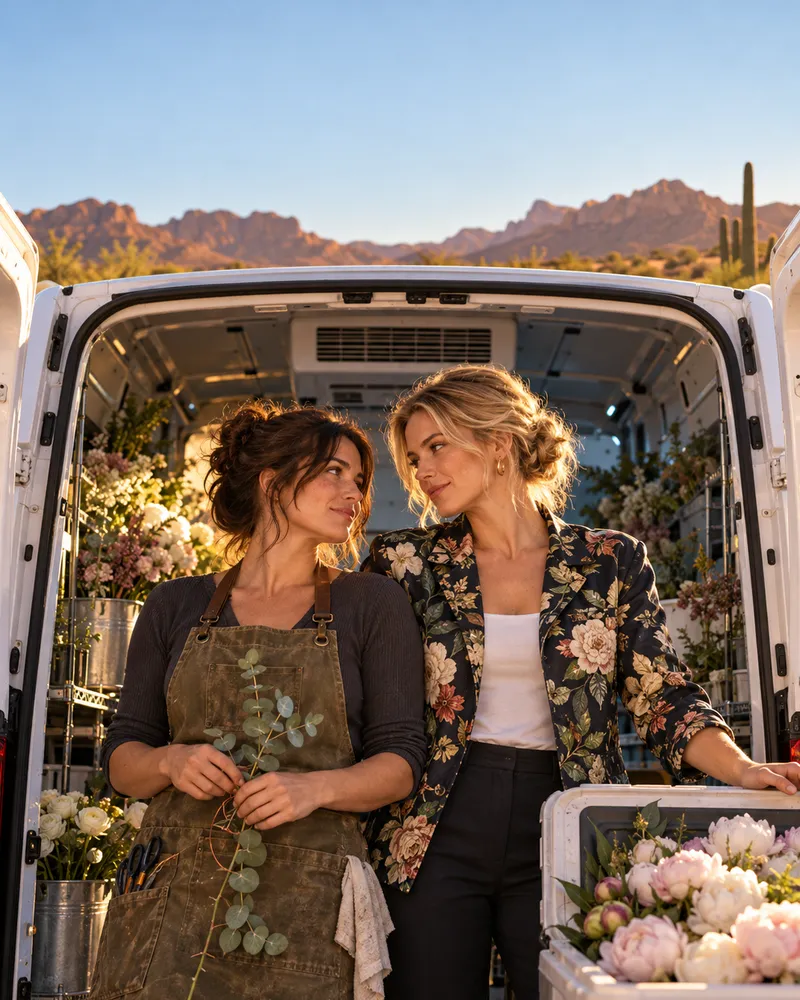
Maren Kessler’s world is built on tension, copper wire, and the smell of damp earth. For three years, she has shared a single refrigerated Ford Transit with her rival, Doss Calloway—a woman whose floral style is to Maren’s architecture what a lush garden is to a modern sculpture. With the prestigious Cinder Mesa Resort contract on the line, the van is no longer just a shared utility; it is the center of a territorial war. When Yael Okonkwo, the resort manager, declares she only wants one supplier, Maren and Doss are forced to face a hard truth: they are competing for the same space in the same vehicle, and neither is willing to be the other’s assistant.
Thorn and Diesel
Maren’s shop on the east side of Cinder Mesa smelled of wet moss and cut stems. On her workbench, a hand-thrown concrete vessel held a sculptural arrangement in progress. She wasn’t just placing flowers; she was engineering them. Using 18-gauge copper wire and a flathead screwdriver, Maren braided pampas grass into a tight, ascending spiral, anchoring it with eucalyptus stems that reached outward like frozen fireworks.
She worked with a focused intensity, her brow furrowed as she tightened a wire loop around a stubborn branch of cedar. In the back room, Sable, her part-time helper, moved through the racks of ranunculus with a misting bottle, the fine spray catching the morning light.
The buzz of the phone broke Maren’s concentration. She glanced at the screen to see Doss Calloway’s message. Doss was everything Maren wasn’t: commercially successful, perfectly timed, and capable of turning a hundred roses into a breathtaking waterfall of pastel color. The text read: Van’s mine Thursday. Resort walkthrough is Friday. You’re not coming.
Maren stared at the words. A thorn from a eucalyptus stem pierced her thumb, leaving a small, bright red puncture. She didn’t pull away; she leaned into the work, wiring the stem firmly before wiping the bead of blood on her canvas apron. Her response was immediate: I’ll be there.
Almost instantly, Doss replied: Yael wants one supplier. Final answer by the 15th. You know the rules.
Maren looked up and gazed through the front window at the parking lot. There sat their shared lifeline: a white Ford Transit refrigerated van. Its compressor ticked in the morning silence, and a faded decal along the lower panel read “Cinder Mesa Floral Logistics.” The side door had a dent from a heavy load of lilies last week, and the paint was peeling under the harsh desert sun.
Sable emerged from the back room carrying two steaming mugs of coffee. She handed one to Maren. “You don’t have to do this alone, Maren.”
Maren took the mug, the heat seeping into her palms. “I’m not.”
She opened her laptop on the workbench and began to type her bid for the resort. She imagined concrete vessels and wired structures transforming Yael Okonkwo’s lobby from a room into an experience. The one-supplier rule was the pressure point, but as Maren looked at her sculptural helix, she knew she wasn’t ready to shrink her vision to fit someone else’s brand.
Cold Zone, Dry Zone
Thursday arrived with a brutal desert heat that shimmered over the asphalt. Maren and Doss stood in the back of the van, their shoulders brushing as they navigated the tight space to load for two different jobs.
Doss was preparing for a church wedding in town, her side of the van filled with insulated coolers brimming with peonies and garden roses—clouds of pink and white, fragrant and fragile. Maren was loading sculptural centerpieces for a private estate on the south ridge: heavy concrete vessels wrapped in foam to prevent sliding, topped with architectural arrangements of dried grasses and eucalyptus.
“The peonies go in the cold zone, back left,” Doss commanded, sliding a cooler into place. “If they hit the edge of the heat, they’ll wilt before we even hit the highway.”
Maren shifted a forty-pound concrete pot with a grunt of effort. “And the vessels go in the dry zone, back right. If they sit too close to the coolers, the condensation will dampen the dried grasses and ruin the tension.”
Doss paused, looking at the massive pots. “You can’t actually put forty pounds of concrete in the back of a Transit without risking the suspension, Maren.”
Maren grinned, tightening her grip on a vessel. “Watch me.”
They climbed into the cab, the compressor humming to life against an 84-degree ambient temperature. Inside the van, the air split: the crisp, chilly embrace of the cold zone and the stable, temperate stillness of the dry zone. As they drove toward the south ridge, Doss’s hand rested on the gearshift; Maren’s hand hovered near the dashboard. For a moment, their fingers brushed. Maren held her breath.
“Yael’s been with me for three seasons,” Doss said. “She knows my numbers.”
“And Yael’s been with me for one private job,” Maren replied. “She knows my work.”
At the estate, they worked side-by-side. Doss tucked a garden rose into a pastel tier, her fingers nimble and quick, ensuring each bloom had exactly enough room to breathe. Beside her, Maren gripped a stem of eucalyptus and twisted a loop of copper wire around it, pulling the branch into a precise, architectural curve.
As they loaded back up for the trip home, Doss paused by the van door and looked at Maren’s finished work. “Good work, Maren,” she said.
“Good work, Doss,” Maren replied.
They drove back toward town in a comfortable silence. The decal on the side of the van—Cinder Mesa Floral Logistics—flickered past the same mesquite trees they saw every day, but the air between them felt lighter.
One Throat to Choke
Friday morning found Maren and Doss in the resort’s conference room, sitting four feet apart on the same side of a long mahogany table. Yael Okonkwo sat at the head, her presence as pragmatic as her linen suit. The room smelled of lemon polish and the faint sweetness of lobby orchids.
Yael laid a notepad on the table. “The resort is booking out for the next two seasons,” she began. “I need one supplier. One point of contact. One invoice. I want one throat to choke.”
Maren leaned forward and slid her proposal across the table—a series of sketches showing sculptural designs: helix forms, single stems held in tension, and heavy concrete bases. “My approach is design-first,” Maren explained. “I create focal points that act as art.”
Doss followed suit, sliding a detailed spreadsheet toward Yael. Her proposal was a masterclass in logistics: delivery windows, volume capacity, and a structured crew schedule. “My approach is reliability,” Doss said. “I provide the abundance and scale that make a venue feel lush.”
Yael looked from the sketch to the spreadsheet. “Here is the truth,” Yael said. “I’ve used Doss for three years. I know her numbers. But my top clients for the coming season are asking for design. Structure. Something with a point of view. And I don’t know how to ask Doss for that without insulting her.”
She turned to Maren. “And I don’t know how to ask Maren for volume without insulting her.”
Yael closed her notepad with a definitive snap. “You have until the 15th. One supplier. I need one name on that contract.” She paused. “Before I make my call, I want to see a test delivery. Tuesday. Both of you. One shipment. I’ll be watching.”
As they walked out into the parking lot, the van sat under the shade of a sprawling mesquite tree. The heat flattened the light, turning the world a blinding white.
“You should withdraw,” Doss said softly as she reached for the van door.
“You should withdraw,” Maren countered.
Doss stopped and looked at her. “I can’t. I have a crew to pay and a lease on my studio.”
“And I have a shop to build,” Maren replied.
They stood there, the van positioned exactly between them. Neither got in immediately; they simply stared at each other, two rivals realizing that while they were fighting for one spot, they were using the same tool to get there.
Breaker
Tuesday arrived with a sky so white it felt heavy. The test shipment was a hybrid of their strengths: Doss’s peonies and roses occupied the cold zone, while Maren’s sculptural concrete vessels sat in the dry zone. Doss was driving, her eyes fixed on the horizon, while Maren remained in the back, adjusting a foam wrap around a delicate helix of eucalyptus.
Halfway to the resort, the hum of the compressor vanished. The silence was abrupt. Maren glanced at the temperature gauge; it began to climb. 78 degrees. 82. 85.
“The cooling’s gone!” Maren called out.
Doss pulled over onto the dusty shoulder of the desert highway. She leaped from the cab and flung open the hood, staring down at the engine with a look of panic. “It’s the compressor,” Doss muttered. “If we don’t get it back on in ten minutes, the peonies are going to start drooping.”
She reached for her phone to call a mechanic, but Maren was already climbing out of the back. She peered into the mechanical maze of the engine and spotted a loose connection at the compressor relay—a single wire that had shaken free from its terminal.
Maren reached into her apron pocket and pulled out her flathead screwdriver. While Doss watched, Maren leaned in, positioned the tip of the screwdriver against the terminal, and tightened the connection with a quick twist. She tapped the relay housing twice.
The compressor kicked back on with a satisfying thrum. The temperature gauge stopped its ascent and began to dip.
“You know how to fix a van,” Doss said.
Maren wiped her greasy hands on a rag. “I’ve fixed a lot of things in my shop. You find the thing that’s disconnected and you reconnect it.”
They sat in the cab for a few minutes as the engine idled, the compressor humming.
“I owe you for that,” Doss said.
“You don’t owe me anything,” Maren replied.
Doss hesitated. “Coffee. This week. My treat. Not a delivery. Not a work thing. Just coffee.”
Maren felt a spark of curiosity. “I’ll think about it.”
When they arrived at the resort, Yael inspected the shipment. She touched a peony stem and then turned one of Maren’s concrete vessels in her hands, nodding. “Good,” Yael said simply.
As they drove home, Doss looked over at Maren. “I’m sorry I said you weren’t coming to the walkthrough.”
“You were protecting your crew,” Maren noted.
“Actually,” Doss admitted, “I was protecting myself. I don’t know how to do the design part as well as you do. I’ve been faking it for two years.”
Maren reached over and turned on the radio, selecting a low, warm melody. The silence between them had changed; it was no longer a gap, but a space they were happy to share.
Garnish
Wednesday afternoon found Doss in Maren’s shop, unannounced and carrying a manila folder. She sat on the edge of the wooden worktable, her boots clicking against the floorboards. On the table beside them, a half-finished concrete vessel held a helix of eucalyptus that caught the shifting afternoon light.
Doss opened the folder. “I’ve been thinking about Yael’s ‘one supplier’ rule,” she said warmly. “What if you became my design consultant? You’d handle the sculptural work for the resort under my brand. My name on the contract, my name on the van, and your name in the fine print: Design by M. Kessler.”
Maren listened, her eyes fixed on the eucalyptus helix. Doss continued, “You’d get the design credit and the shop visibility. You’d get the volume I can’t produce alone, and Yael gets one name on the invoice.”
Maren remained silent for a long beat. She thought of the word consultant. In her mind, she was the garnish—the beautiful sprig of parsley on top of a perfectly cooked meal.
“No,” Maren said.
Doss flinched slightly. “You don’t have to decide right now, Maren.”
“I just did,” Maren replied. She picked up a length of copper wire and began bending it into a tight loop. “If I’m in this, I’m not on top of it or under it. I want to be beside it.”
Doss looked at her, really looking at her. Doss shifted on the table, her voice softening. “I said I was faking the design part. And I am. And I’m still scared that if I don’t have a system, everything will fall apart. This proposal… it’s the only structure I know how to build.”
Maren stopped bending the wire. She looked at Doss—not as a rival, but as a woman who was running on fumes despite her success.
“I don’t want to be your consultant, Doss,” Maren said softly. “And I don’t want you to just be my logistics manager.”
Doss stood up and picked up her folder, but she didn’t leave immediately. She looked at the concrete vessel on the table, then back at Maren. “Then what do we do?”
“We change the question,” Maren said.
As Doss left the shop, the compressor ticked outside in the parking lot. Maren turned back to her wire and concrete, building a new way forward.
Two Names
Thursday, the 15th, arrived with a crispness that signaled the peak of spring. Maren walked into Yael’s office alone, carrying a folder containing two pages. The first page was a jointly credited supplier arrangement: Maren Kessler and Doss Calloway.
It wasn’t a compromise; it was a restructuring. Maren had proposed they be equal partners. Maren would lead the design credit, and Doss would lead the logistics credit. Both names would appear on the contract, both names would be on the invoices, and most importantly, both names would go on the van.
The second page was a simple statement: We are not a two-van operation. We are a florist and a florist, and the work is better because of it.
Yael read the proposal slowly. She set the folder down and looked at Maren. “Where’s Doss?”
“She’s not in this room,” Maren replied. “But she’s a part of the plan.”
Yael smiled. “She needs to sign this.”
Maren nodded. Yael picked up the phone and called Doss. Four minutes later, Doss arrived, still in her work clothes with streaks of soil on her jeans. She sat down beside Maren and read the proposal.
As she reached the part about “both names on the van,” Doss looked at Maren. Doss picked up the pen and signed her name in bold script right beside Maren’s.
Yael stamped the contract with a satisfying thud. “I’ll have the van re-lettered by Monday,” Yael announced.
“We’ll put both our names on it,” Maren said. “You just never asked us to.”
As they stood to leave, Doss paused and turned to face Maren.
“Maren,” Doss said, her voice steady but hopeful. “I’d like to take you to dinner. Not a delivery. Not a deadline. Not a proposal. Just… dinner. And I’d like to ask you out. And I’d like you to say yes.”
Maren looked at Doss and smiled. “Yes,” Maren said. “I definitely say yes.”
They walked toward the van together, their shoulders brushing. The compressor ticked in the quiet afternoon air, and the generic decal Cinder Mesa Floral Logistics waited for its new identity.
No Route
The sun was dipping toward the horizon, painting the Cinder Mesa sky in shades of amber and deep violet. The resort parking lot was quiet, the air cooling as the desert heat retreated. Maren sat in the passenger seat of the van, her feet tucked up on the dashboard. Doss sat in the driver’s seat, her hands resting lightly on the wheel.
The contract was safely tucked into the glove compartment. On the dashboard, the route map was blank. There were no delivery windows to hit and no clients waiting for their centerpieces.
Doss turned the key, and the engine roared to life. The compressor kicked on with a steady, rhythmic hum.
“So,” Doss said, glancing at Maren. “Dinner.”
“So,” Maren replied. “Dinner.”
“Where?” Doss asked.
Maren looked out at the sprawling desert. “Anywhere. Not a resort. Not a venue. Not a walkthrough.”
Doss laughed. “A diner. A small one on the east side. The one with the bad coffee and the good pie.”
“Yes,” Maren said. “That’s exactly where we should go.”
As they pulled out of the parking lot, the van glided smoothly over the asphalt. They passed a large billboard for the resort featuring a photograph of the lush lobby gardens. Maren pointed toward it.
“That’s us now,” Doss said.
Maren leaned her head back against the seat. “That’s us now,” she corrected softly.
The road stretched out before them, open and inviting.
“What are you going to build first?” Doss asked as they turned onto the main road. “Under the new contract.”
Maren thought of the copper wire and the concrete. “I don’t know yet,” she admitted. “Something with copper wire. And a single stem of something that isn’t even a flower. Maybe a piece of driftwood. Or a bleached bone from the mesa.”
Doss looked at Maren, her expression warm. “I’ll get you the wire.”
The light shifted to a deep, saturated gold as they drove further into the desert. There was no route map to follow and no pressure to perform. They didn’t touch; they simply existed in the same humming space, moving together toward the east side of town.
The compressor ticks.