Thriller · Thursday
What the Hands Told
The witness answers aloud, but her hands convey a warning. Only the sketch artist understands—and the judge's ruling is five minutes away.
Charcoal on the Rail
Wren Kline worked in the periphery, her world defined by the scratch of charcoal against heavy paper. She was mid-stroke, sketching the curve of the judge’s bench, when she felt the room settle into a fragile equilibrium. The air smelled of old carpet and cold coffee, a scent that always clung to the domestic-relations courtroom of the Harrison County Courthouse. Above her, a dying fluorescent tube flickered, casting a jittery light over the jury box and humming at a frequency that made the silence feel heavy.
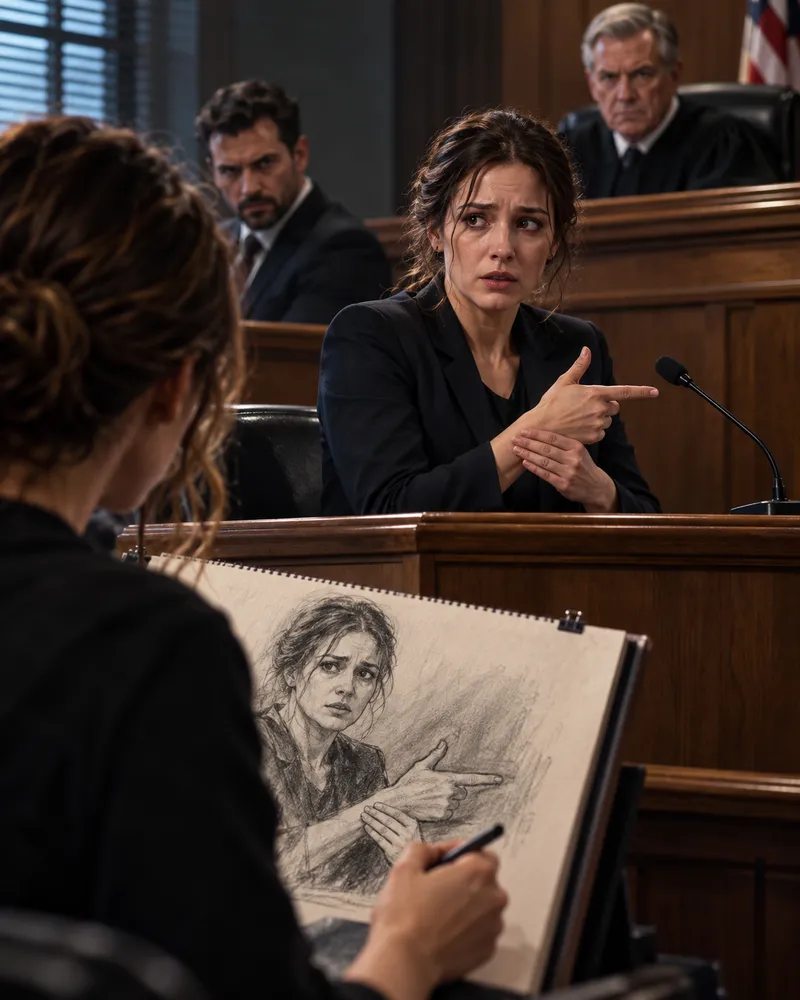
She looked at the witness box. Cordelia Sutter stood there, her body rigid, her palms pressed flat against the polished wooden rail. Cordelia was not just waiting; she was enduring. Her left hand performed a rhythmic, nervous tic—tap, tap, tap—a small metronome of anxiety that never quite broke her composure.
At the respondent’s table, Darrin Sutter sat with his back to the wall, facing the exits. He was a man of calculated stillness. His right hand rested loose on the table, while his left remained buried in his jacket pocket. He wasn’t fidgeting. He was counting. Every few seconds, his eyes performed a slow, patient sweep: the door, the judge’s file, the witness box, and back to the door.
Wren shifted her gaze back to Cordelia. Suddenly, the petitioner’s hands left the rail. They didn’t move in a frantic wave; they formed shapes—sharp, intentional arcs of American Sign Language aimed directly at Wren.
Can you read this? the first sign asked.
Wren froze. Her charcoal tip hovered a millimeter above the paper. She nodded once, a small movement that kept her head low and out of Darrin’s direct line of sight.
Cordelia signed again, her movements crisp despite the tension in her shoulders. GUN. Then: NOON. Finally: HIM.
Four signs. Four words. The message was a death warrant delivered in silence. Cordelia’s hands dropped back to the rail, but her jaw remained clenched so tight that the masseter muscle jumped when she swallowed. She stared at Wren with wide, pleading eyes.
Wren’s thumb pressed the charcoal flat against the pad. Under the pressure, the tip snapped with a sharp crack. A small black fragment rolled off the edge of the paper and landed on the worn carpet.
Wren didn’t look down. She looked at Darrin. He was still watching the door, his jaw working slowly as he processed the ticking seconds. He wasn’t looking at Cordelia, nor was he looking at Wren. He was waiting for the right moment to strike.
The wall clock above Judge Braddock’s bench read 11:55. The second hand swept forward with a relentless, rhythmic click. The fluorescent tube buzzed, the coffee on the clerk’s desk grew colder, and the room held its breath. In the witness box, a woman’s hands gripped a rail; in the respondent’s chair, a man’s hand waited in his pocket; and at the sketch table, Wren Kline stared at the gap between them, wondering how to bridge it without making a sound.
The Table Is Bolted
Wren looked down at her feet. Six feet of open, beige carpet separated her from Cordelia. The pale stripe where the bailiff usually paced ran through the center of that distance like a highway. To reach Cordelia, Wren would have to cross the room in full view of Darrin, who was currently monitoring the exits with the intensity of a hawk.
She tried to lift her charcoal, but her hand trembled slightly. She looked at the table beneath her arms—a heavy, eighteen-inch wide slab of birch bolted firmly to the wall behind the jury box. This table was her sanctuary and her prison. If she stayed, she was safe from Darrin’s immediate reach; if she moved, she became a target.
As she sat there, the body memory of her childhood flooded back. She could almost smell her grandmother’s kitchen—the scent of cinnamon and old pine. She remembered sitting at the small wooden table, watching her grandmother’s hands move in that same low, deliberate register. The skill wasn’t just a line on Wren’s resume; it was etched into her wrists and elbows. Her hands knew the shapes before her mind could even name the words.
Wren decided to test the channel. She picked up the broken piece of charcoal and set the tip against the pad. Instead of drawing, she tapped. Tap. Tap-tap. Tap. It wasn’t a sign; it was a rhythmic signal, a heartbeat on paper.
She watched Cordelia’s eyes. The witness’s gaze flicked from the judge to the sketch table. The nervous tapping of Cordelia’s left hand stopped instantly. Her right hand went still on the rail. She was listening with her eyes.
Cordelia’s lips moved, though no sound escaped them. She formed a small, round “O”—the shape of yes.
The tension in Cordelia’s jaw released by a fraction. She swallowed and returned her hands to the rail, but the rhythmic tapping resumed: tap, tap, tap. It was as if she were counting down the seconds until noon along with Darrin.
Darrin’s eyes began their sweep again. Door. Witness box. Judge. Door. His jaw worked in a steady rhythm. He wasn’t just watching; he was calculating. As his gaze returned to the door, his right hand shifted one inch on the table, his fingers curling slightly.
The fluorescent tube above flickered violently. For a heartbeat, the room dimmed, and the buzz dropped an octave before returning to its steady drone. In that flicker, Wren realized the absolute nature of her constraint. She could not speak without risking Darrin’s attention. She could not move without crossing his line of fire. She could not interrupt Judge Braddock, who was still buried in the orange-tabbed file on her desk.
Wren pressed her hands flat against the pad. The broken charcoal felt like a small anchor in her grip. She was a woman at a bolted table with nothing but paper and graphite, facing a man with a 9mm handgun. But as she looked at Cordelia, Wren realized that while Darrin controlled the room’s sound, he had no power over its silence. The ASL channel was a secret bridge, an invisible thread connecting the artist to the witness, hidden right under the nose of the man who couldn’t read it.
Behind the Pad
Wren lowered her hands so they were barely rising above the edge of her sketch pad. To anyone watching from the front of the room, she looked like an artist adjusting her composition. But behind the shield of the birch board, Wren was talking.
I see. I’m with you, she signed. The movements were small and tight—flat palms and short arcs that didn’t require her to move her shoulders.
Cordelia’s reaction was immediate. Her shoulders dropped an inch, shedding a layer of rigid terror. The tension in her neck released, and for the first time since the hearing began, she stopped tapping the rail. She looked at Wren with a newfound sense of alliance.
Wren signed again: He’s watching the door. Not you. Not yet.
Cordelia’s eyes widened. She responded with a single, sharp sign—her hand cutting through the air in a quick motion: WHEN?
Wren glanced at the wall clock. 11:56. The second hand was slicing through the minutes with agonizing precision. She looked at Judge Braddock, whose pen continued to tap a slow rhythm on the desk. Wren signed back: Noon. The ruling. That’s when he moves.
Then came the instruction. Wren raised her hands slightly higher, still keeping them mostly hidden behind the pad. When she speaks, you drop. Behind the stand. Low. Stay low.
Cordelia’s eyes grew wet, but she didn’t blink. She absorbed the command and gave a sharp, singular nod. She signed back one word: OKAY. Her hands returned to the rail, and the metronome of her left hand started again. Tap. Tap. Tap.
Suddenly, Darrin’s eyes swept toward the table. His gaze landed directly on Wren’s moving hands. The rhythm was wrong; the palms were flat and the shapes were deliberate. He paused, his head turning a quarter-inch.
Wren froze. She held the charcoal in mid-air, her breath trapped in her lungs. She didn’t blink. She became a statue of graphite and bone. Darrin’s eyes narrowed, searching for the meaning behind the movement. His right hand on the table tightened, his fingers curling into a claw.
Just as the tension reached a breaking point, Petra, the bailiff, shifted her weight by the door. Her phone buzzed in her hand, and she glanced down at the screen. The sound of her heel tapping the floor was small—a sharp click—but in the oppressive quiet of the courtroom, it sounded like a gunshot.
Darrin’s head snapped toward the door. He watched Petra for a second, his jaw working, before his gaze drifted back to the witness box and finally returned to the door. The danger had passed, but only barely.
Wren let out a slow breath and set her charcoal back down. She drew a single, straight line across the paper—a simple mark to prove she was still an artist at work. But as she looked at Darrin, she saw his hand drift toward his jacket lapel. He was no longer just counting; he was preparing. The orange tab of the file on the judge’s desk seemed to glow under the fluorescent light, a reminder that the final decision was seconds away.
The Pen Taps
11:57. Judge Braddock looked up from the file, her eyes scanning the room with an air of professional patience. She tapped her pen on the mahogany desk—one, two, three times. The sound echoed off the wood-paneled walls, cutting through the hum of the lights.
“We’ll be in order in a moment, please,” Braddock said. Her voice was low and resonant, carrying a weight that demanded attention without needing to shout.
The clerk stopped typing, and the rhythmic clatter of the keyboard died away. The room entered a deeper state of silence. Wren could smell the sharp, metallic scent of the judge’s ink as she paused over her notes. On the desk, the heavy wooden gavel sat waiting, its polished head gleaming under the lights, poised to signal the end of the tension.
Darrin’s right hand rested on his jacket lapel. He wasn’t gripping the gun yet; he was simply keeping his fingers in contact with the fabric, feeling for the cold steel beneath. His left hand lay flat on the table, still as a stone. He was counting the beats of the pen taps, using them as a countdown to his own action.
Wren remained anchored to her bolted table. She wasn’t drawing now; she was using the birch board as a tactical screen. Her left hand held the edge of the pad steady, while her right hand hovered with the charcoal. To keep herself grounded, Wren made a small, deliberate mark on the lower-left corner of the page—a single, round dot.
I’m still here. I’m still watching.
She looked at Cordelia. The witness was no longer signing; she was in a state of pure readiness. Her breathing had shifted to shallow, controlled cycles—in through the nose, out through the mouth. The tapping of her left hand on the rail had slowed, becoming more purposeful. She was counting down with the judge and Darrin, her body coiled like a spring.
The fluorescent light buzzed, then dropped for a half-second. Darrin’s eyes flicked upward to the ceiling, then snapped back to the door. His jaw worked in a steady grind. He was a man who had spent six weeks fighting motions and losing them. The orange tab of the file represented four different legal battles, and as he looked at Cordelia, his expression was one of grim determination.
Wren shifted her weight, feeling the hard edge of the birch board against her forearm. She signed one last word, a tiny movement of the fingers that barely rose above the paper: READY.
Cordelia’s eyes locked onto Wren’s. The tapping stopped. Her thumb pressed deep into the grain of the wooden rail, anchoring her to the spot. She gave a single, sharp nod and turned her gaze back to Judge Braddock.
The clock hit 11:58. The second hand continued its relentless march toward noon. The pen was on the desk, the file was open, and the air in Room 214 felt thick enough to touch. Wren could feel the pressure building—not just the legal pressure of the ruling, but the physical pressure of Darrin’s presence.
The Gavel Has Not Fallen
11:59. Judge Braddock closed the orange-tabbed file with a decisive thud. She looked at the clock, then swept her gaze across the room. Petra, the bailiff, slid her phone into her pocket and stood straight, her attention finally shifting from the screen to the players in the room.
“Court is in session,” Braddock announced.
The words landed like a stone in a still pond. The atmosphere shifted instantly; the air grew heavy with the weight of an impending verdict. Braddock picked up her pen and uncapped it with a loud, plastic click. The clerk’s fingers hovered over the keyboard, ready to record every word.
Darrin Sutter finally turned his head away from the door. His eyes locked onto Cordelia in the witness box. He wasn’t looking at her as a person so much as a target. His right hand tightened on the lapel of his jacket, his knuckles turning white. His breathing was slow and rhythmic—in, out, in, out—the breath of a man who had already decided how this hour would end.
Wren squared her shoulders and locked her left elbow against the table, pulling her right shoulder back to create room for movement. She felt the eighteen-inch rectangle of birch board beneath her palms. It was no longer just a support for her paper; it was a weapon. If she timed it correctly, the board would act as a hammer, and Darrin’s forearm would be the nail.
Judge Braddock began to speak. “In the matter of Sutter versus Sutter, the court will now enter its ruling.”
The words were procedural and flat, but they acted as a trigger. As Braddock continued, “The court finds that the petitioner has demonstrated a credible threat of imminent harm and that a protective order is necessary to ensure her safety,” Darrin’s eyes flared.
He didn’t wait for the judge to finish the sentence. He didn’t wait for the gavel to fall. As soon as the words protective order left Braddock’s lips, Darrin began to pull the gun from his jacket.
In that exact heartbeat, Cordelia moved. Following Wren’s instruction, she didn’t scream or run; she simply dropped. Her palms left the rail and her body sank rapidly behind the wooden barrier of the witness stand. She vanished from Darrin’s line of sight, her forehead nearly touching the floor, her hands flat against the carpet.
Wren saw the movement—the drop of the witness and the rise of the weapon. She didn’t think; she reacted. Her right shoulder snapped forward, and she lifted the birch board high above her head.
The room was a blur of motion: the judge’s voice still echoing, Cordelia tucked away in safety, and Darrin stepping forward to claim his target. The clock hit 12:00 exactly. The gavel had not yet fallen, but the strike was already in the air. Wren swung the board down with every ounce of strength in her arm, aiming for the exact spot where Darrin’s right forearm was beginning to extend toward the witness box.
Eighteen Inches of Birch
The board collided with Darrin’s right forearm with a flat, hard thwack. It sounded like a heavy book slamming shut on a desk. The birch hit the bone squarely, jarring Darrin’s entire frame. His arm jerked violently to the left, and his fingers snapped open in a sudden spasm of surprise.
The 9mm pistol flew upward for a fraction of a second. Darrin’s head snapped toward Wren. His eyes were wide, filled with genuine shock. He had spent the last hour treating Wren as part of the furniture; he hadn’t expected the quiet woman at the wall to become an active participant in his drama.
Before the gun could hit the floor, Judge Braddock reacted. Her center of gravity shifted forward, her hand leaving the bench in a blur of motion. She lunged toward Darrin, gripping his wrist firmly and pulling the weapon away from him as it descended.
Braddock stepped back and set the gun on the mahogany bench with a small, metallic click. Her face wasn’t angry; it was settled. She looked at Darrin with an expression of absolute authority. “Bailiff,” she commanded.
Petra moved instantly. Her phone hit the carpet with a soft thud as she lunged toward Darrin’s left side. She gripped his shoulder, her fingers digging into the fabric of his jacket to keep him pinned against his chair.
“Sir. Step back. Step back now,” Petra said, her voice flat and procedural.
Darrin sank back into his seat, his right arm still tingling from the impact of the board. His hands were empty, resting uselessly on the table. He looked defeated, his jaw finally relaxing as he realized the moment of power had slipped through his fingers.
Behind the witness stand, Cordelia remained on her knees for a few seconds longer. She breathed in through her nose and out through her mouth, her chest rising and falling in slow, rhythmic waves. Her left hand was no longer tapping; it was pressed flat against the cool floor. When she finally peeked over the edge of the rail, her eyes found Wren.
Wren was still standing, the birch board clutched in her left hand and a piece of broken charcoal in her right. Her hands were shaking now—a delayed reaction to the adrenaline. She slowly lowered the board back onto the table with a flat thud and set the charcoal down beside it.
She sat back down, her breath coming in ragged gasps. On the pad before her, the sketch remained: the courtroom, the two Sutters, and the judge. But as she looked at the page, she realized she had added something new in the margin during the chaos. In the lower corner, she had scribbled two small hands—one signing a message of hope, and one holding a birch board.
Judge Braddock looked at Wren. It wasn’t just a look of gratitude; it was recognition. The judge saw the woman who had seen the threat, read the silence, and acted before the crisis could peak.
“Clerk, take a recess,” Braddock said softly. She looked at Wren one last time and added a quiet, “Thank you.”
The Hands Are Quiet
Ten minutes later, the courtroom began to exhale. The frantic energy of the noon hour settled into a calm, rhythmic hum. The clerk was packing her keyboard, and the stenographer was closing her laptop with a soft snap. The fluorescent tube above the jury box continued its erratic buzz, and the carpet remained worn to a pale stripe where Petra had paced during the standoff.
In the back row of chairs, Darrin Sutter sat in handcuffs. His jaw was tight, his eyes fixed on the door. He was no longer the predator; he was the prisoner. He didn’t look at Wren or Cordelia; he simply watched the exit, as if still calculating his next move or perhaps reflecting on the one he had almost made.
Cordelia stood behind the witness stand, her body finally relaxed. Petra kept a steadying hand on her shoulder, her fingers grounding the woman who had spent weeks living in fear. Cordelia wasn’t tapping anymore. She was looking toward the door, envisioning the world outside the courthouse walls.
Wren stayed at her table, staring at her sketch. The charcoal lines were smudge-heavy and bold. In the margin, those two small hands seemed to dance on the page. She realized that her hands, which had spent the morning translating silence into action, were finally starting to stop shaking.
She capped her charcoal and slid the pad into its protective case. As she stood to leave, she walked past the witness box. Cordelia looked up, their eyes meeting in a moment of shared understanding. There were no words—no “thank you,” no formal greeting. Cordelia simply nodded once, a slow and meaningful gesture. Wren nodded back, a silent acknowledgement of their secret partnership.
Wren walked out of Room 214 and down the long, echoing hallway. She passed the water fountain and the bulletin board where the day’s court schedule was pinned in neat columns. When she pushed open the side door, the November air hit her face—cold, clean, and smelling of wet leaves and distant exhaust.
She stood on the cracked flagstone steps of the Harrison County Courthouse. Behind her, the rusted handrail felt cold beneath her palm. She looked up at the sign: HARRISON COUNTY COURTHOUSE, EST. 1962.
At the curb, a car began to pull away. Petra was driving, and Cordelia was in the back seat. As the car turned the corner, Cordelia looked back through the window and gave one last nod. Wren watched until the taillights disappeared around the bend of the street.
Wren slid her hands into her pockets. The shivering had stopped. She took a deep breath of the crisp autumn air and began the walk toward her car. The courtroom was behind her, the gun was on the bench, and the sketch was safe in its case. For the first time all morning, the hands were quiet.